Aug 14, 2026Crane Knowledge
European Overhead Crane vs Conventional Crane with VFD
Can a VFD make a conventional overhead crane as smooth as a European crane? Compare motion control, mechanical design, positioning and overall performance.
European Overhead Crane vs. Conventional Crane with VFD: Is a VFD Enough?
"Isn't the smooth movement just because of the variable frequency drive?"
This is a good question.
A Variable Frequency Drive, or VFD, can certainly improve the starting, stopping and speed control of a conventional crane.
But is simply adding a VFD enough to make a conventional overhead crane perform like a European overhead crane?
Not necessarily.
The reason is simple:
Crane performance depends on the entire system, not only the VFD.
European-type overhead cranes are typically designed around coordinated mechanical, electrical and control systems from the beginning.
A conventional crane can also be equipped with modern VFD control, but the final performance depends on how well the complete crane system is engineered and matched.
What Does a VFD Do on an Overhead Crane?
A Variable Frequency Drive controls the frequency and voltage supplied to the motor.
By controlling motor speed, a VFD can help provide:
- Smooth acceleration
- Smooth deceleration
- Adjustable travel speed
- Reduced starting shock
- Better speed control
- More controlled positioning
For example, instead of the crane moving immediately from zero speed to full speed, the VFD can gradually increase the motor speed.
This can reduce sudden acceleration and make material handling more comfortable for the operator.
So yes:
A VFD can significantly improve crane movement.
But this is only one part of the picture.
Why Doesn't a VFD Alone Define Crane Performance?
Imagine two cranes.
Crane A
- Conventional mechanical structure
- Standard transmission system
- Standard brake
- VFD added later
Crane B
- Optimized crane structure
- Compact hoisting system
- Matched motors and drives
- Coordinated braking
- Optimized transmission
- VFD control
- Integrated control system
Both cranes may use VFDs.
But they do not necessarily have the same operating characteristics.
Why?
Because the crane's smoothness is affected by the interaction between the:
Motor + Gearbox + Brake + Wheels + Rail + Structure + Controls + Load
This is why comparing cranes only by asking:
"Does it have a VFD?"
is not enough.
European Overhead Cranes Are Designed as an Integrated System
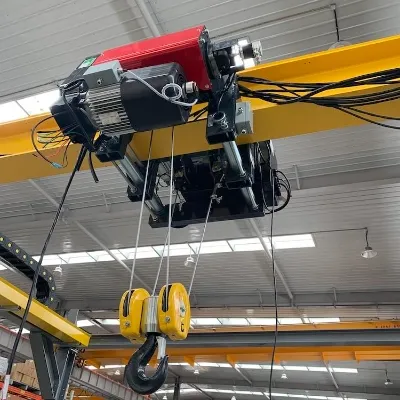
One important characteristic of modern European-type cranes is system integration.
The crane is typically designed as a complete system rather than as a collection of unrelated components.
The manufacturer may coordinate:
- Motor
- Gearbox
- Brake
- Hoist
- Trolley
- Crane travel mechanism
- VFD
- Control system
- Structural design
The objective is to make the different components work together.
This can help improve:
- Acceleration control
- Deceleration control
- Load positioning
- Travel smoothness
- Mechanical stress management
- Operator control
This is the real difference between:
"A crane with a VFD"
and
"A crane designed around an integrated motion-control system."
Does Adding a VFD to a Conventional Crane Improve Smoothness?
Yes.
A properly selected and configured VFD can make a conventional crane noticeably smoother.
For example, it can reduce the sharp motion that occurs when a motor starts or stops at full speed.
This can help reduce:
- Shock loading
- Sudden load movement
- Material swinging
- Operator discomfort
- Mechanical impact
For many general-purpose applications, upgrading a conventional crane with VFD control can be a practical and cost-effective improvement.
So it would be incorrect to say that a conventional crane with VFD "cannot be smooth."
It can.
The real question is:
How smooth and how precise does your application require the crane to be?
Where Can European Cranes Have an Advantage?
European-type cranes may have an advantage when the customer wants a higher level of overall motion control.
Typical applications include:
- Precision manufacturing
- Machinery assembly
- Mold handling
- Automotive production
- Electronics manufacturing
- Equipment assembly
- High-frequency material handling
These applications may benefit from:
- Smooth acceleration
- Controlled deceleration
- Reduced swinging
- Fine speed control
- Repeatable positioning
But again, these advantages come from the whole crane system, not from the VFD alone.
Smoothness Is More Than Motor Speed
This is one of the most important points.
Even if a VFD controls motor speed smoothly, the crane can still experience unwanted movement due to other factors.
For example:
Mechanical Backlash
Gearbox and transmission backlash can affect positioning.
Brake Performance
If the brake engages too aggressively, stopping can still feel abrupt.
Wheel and Rail Condition
Poor wheel alignment or rail condition can create vibration and uneven travel.
Structural Flexibility
A crane structure with greater elasticity may respond differently to acceleration and braking.
Load Swing
A suspended load naturally behaves like a pendulum.
Even a highly controlled motor cannot eliminate all load swing without appropriate control and operating techniques.
Therefore:
Smooth crane motion is a system-level result.
Why Is Load Positioning Important?
For general material handling, moving the load from Point A to Point B may be enough.
But some factories need more accurate positioning.
For example:
Machine A → Assembly Station → Inspection Station
The operator may need to position the load accurately several times per hour.
In these situations, the control characteristics of:
- Motor
- VFD
- Brake
- Transmission
- Trolley
- Crane travel system
all affect the final positioning result.
This is where a properly integrated crane system can provide an advantage.
Can a Conventional Crane Achieve High-Precision Positioning?
Yes, depending on its design.
A conventional crane can be upgraded with:
- VFDs
- Soft starters
- Encoders
- Positioning systems
- Radio remote controls
- Anti-sway systems
- PLC control
With the correct configuration, a conventional crane can achieve very good motion control.
So the difference should not be described as:
Conventional crane = rough
European crane = smooth
That is too simplistic.
A better comparison is:
Basic conventional crane + basic controls
versus
Optimized crane + integrated motion control
The final performance depends on the actual engineering configuration.
European Crane vs. Conventional Crane with VFD
Here is a simple comparison.
Feature | European-Type Crane | Conventional Crane + VFD |
|---|---|---|
VFD available | Usually integrated | Can be added |
Mechanical optimization | Usually designed as a complete system | Depends on original design |
Motor/drive matching | Typically coordinated | Depends on retrofit |
Brake coordination | Designed with system | Depends on existing brake |
Compact design | Common | Depends on crane |
Motion control | Potentially very high | Can also be very good |
Precision positioning | Suitable for demanding applications | Possible with upgrades |
Retrofit potential | Not the main purpose | Major advantage |
Initial cost | Usually higher | Often lower |
Upgrade flexibility | Depends on system | High |
The key point is:
A VFD is a control component, not a complete crane design.
Why Does the Mechanical Design Matter?
Suppose two cranes have the same motor and the same VFD.
One crane has:
- Better wheel alignment
- Optimized gearbox
- Better brake coordination
- More rigid structure
- Lower mechanical backlash
The other has:
- More mechanical clearance
- Older transmission components
- Less optimized brakes
- Greater structural flexibility
The electrical control may be identical.
But the operating result can still be different.
This is why professional crane selection should evaluate the complete system.
What About Starting and Stopping?
This is where VFD control is particularly useful.
Without appropriate speed control, a crane may:
Start suddenly → accelerate quickly → stop suddenly
With a properly configured VFD, the movement can be:
Start smoothly → accelerate gradually → decelerate gradually → stop more gently
This can reduce unnecessary shock and make the crane easier to control.
However, the acceleration and deceleration settings must be correctly configured for the crane and load.
Too aggressive a setting can still create undesirable movement.
Does European Crane Mean Lower Maintenance?
Not automatically.
Maintenance requirements depend on:
- Crane design
- Component quality
- Working class
- Operating frequency
- Environment
- Operator habits
- Maintenance program
European-type cranes may use modern components and optimized systems, but they still require regular inspection and maintenance.
A good maintenance plan remains important.
Is a European Overhead Crane Worth the Extra Cost?
That depends on the application.
For a small workshop that operates a crane occasionally, a basic conventional crane with VFD may provide excellent value.
For a production plant where the crane:
- Operates frequently
- Requires controlled movement
- Needs efficient use of building space
- Handles precision equipment
- Requires repeatable positioning
a European-type crane may justify the higher initial investment.
The decision should be based on:
Application + operating frequency + required control performance + total cost of ownership
rather than simply:
VFD or no VFD
When Should You Choose a Conventional Crane with VFD?
A conventional crane with VFD can be a good option when:
- Your budget is limited
- Existing equipment is still in good condition
- You want smoother starting and stopping
- Your application does not require advanced positioning
- You want to upgrade an existing crane
- The working environment is relatively simple
For many general manufacturing applications, this can be a practical solution.
When Should You Consider a European Overhead Crane?
A European-type crane may be worth considering when:
- Building headroom is limited
- High hook height is important
- The crane operates frequently
- Smooth movement is important
- Positioning accuracy matters
- The workshop needs a compact crane design
- You want an integrated modern control system
- You are building a new production line
This is particularly relevant to modern machinery, automotive, precision manufacturing and assembly applications.
How to Compare Two Crane Quotations Correctly
When comparing a European crane with a conventional VFD crane, don't only compare:
Price + Motor Power + VFD Brand
Also compare:
Mechanical System
- Girder design
- Hoist design
- Gearbox
- Wheels
- Bearings
- Brake
Electrical System
- Motor
- VFD
- PLC
- Control panel
- Limit switches
Structural Performance
- Self-weight
- Wheel load
- Hook height
- Deflection
- Duty class
Operating Performance
- Lifting speed
- Trolley speed
- Crane travel speed
- Acceleration
- Deceleration
- Positioning requirements
This gives you a much more meaningful comparison.
FAQ About European Cranes and VFD
Is a VFD enough to make a conventional crane as smooth as a European crane?
Not necessarily.
A VFD can significantly improve acceleration, deceleration and speed control, but crane smoothness also depends on the mechanical structure, gearbox, brake, wheels, rails, controls and load.
Does a European overhead crane always use a VFD?
Not every European-type crane configuration is identical.
VFD control is common in modern crane systems, but the exact electrical configuration depends on the manufacturer and application.
Can I add a VFD to my existing overhead crane?
In many cases, yes.
However, the motor, brake, electrical system, gearbox and operating requirements should be checked before a VFD retrofit.
Is a European crane always more precise?
Not automatically.
Precision depends on the complete control and mechanical system.
A well-engineered conventional crane with appropriate VFD and positioning technology can also provide high performance.
Why does my crane still shake after installing a VFD?
Possible causes include:
- Poor acceleration settings
- Mechanical backlash
- Brake problems
- Wheel or rail alignment
- Structural flexibility
- Load swing
- Incorrect motor or VFD configuration
A VFD does not automatically eliminate all mechanical or load-related movement.
Is a European crane worth the higher price?
It depends on the application.
For high-frequency or space-limited applications, the additional investment may provide better overall value.
For simple applications, a conventional crane with VFD may be more economical.
What is the biggest advantage of a European overhead crane?
The main advantage is not simply the VFD.
It is the integration of structural, mechanical, electrical and control systems into one optimized crane design.
Which is better for a small factory?
For a small factory with light or moderate crane usage, a conventional crane equipped with VFD may offer a good balance between price and performance.
A European crane becomes more attractive when space, hook height, working frequency and motion control are important.
Final: A VFD Is Important, But It Is Not the Whole Crane
A VFD can make an overhead crane smoother.
That is true.
But a VFD is only one component.
The actual performance of the crane depends on:
Motor + VFD + Brake + Gearbox + Wheels + Structure + Controls + Load
A European-type crane is generally designed around these systems as a complete package.
A conventional crane can also achieve very good performance with a well-designed VFD retrofit and appropriate mechanical and control upgrades.
So the right question is not:
"Does the crane have a VFD?"
The better question is:
"How well are the mechanical, electrical and control systems matched to my application?"
For a simple workshop, a conventional crane with VFD may be the better-value solution.
For a modern production line requiring compact design, frequent operation and controlled positioning, a European-type overhead crane may be worth the additional investment.
Choose the crane based on the actual application, not just the presence of a VFD.