Aug 24, 2026Crane Knowledge
How to Install a Gantry Crane: Installation Process & Safety Guide
How is a gantry crane installed? Learn the main installation process from main girder preparation and leg assembly to hoist installation, lifting and ground beam connection.

How Is a Gantry Crane Installed?
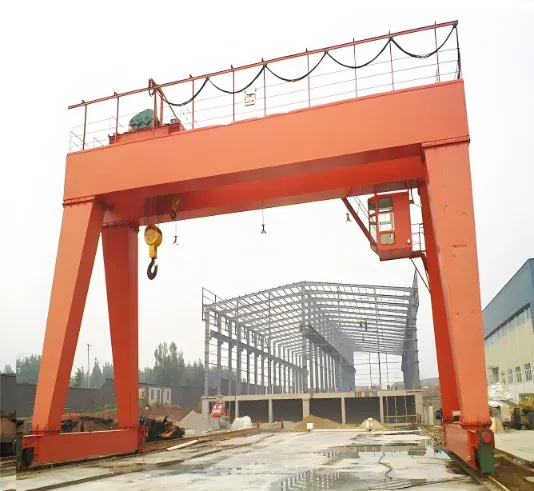
A gantry crane is much larger after assembly than during transportation.
For export and long-distance delivery, the crane is normally shipped in separate sections, such as:
- Main girder
- Supporting legs
- Ground beams
- Electric hoist or trolley
- Electrical components
- Rails and accessories
These components are then assembled and erected at the customer's site.
So, how does a gantry crane go from several separate steel structures to a complete lifting machine?
This article explains the general gantry crane installation sequence.
Important: Gantry crane erection is a high-risk lifting operation. The actual lifting points, temporary supports, rigging, auxiliary crane capacities and erection sequence must follow the manufacturer's approved installation plan and be carried out by qualified personnel. This article is an overview, not a site lifting plan.
Step 1: Check the Site Before Installation
Do not start by immediately lifting the main girder.
Before erection begins, the installation team should first check the site conditions.
Important items include:
- Crane drawings
- Component dimensions
- Component weights
- Rail gauge
- Rail level and alignment
- Foundation condition
- Available erection space
- Mobile crane working position
- Ground bearing capacity
- Overhead obstacles
- Power supply
For a rail-mounted gantry crane, the runway is particularly important.
Incorrect rail gauge, poor alignment or foundation problems can lead to abnormal crane travel after installation.
Step 2: Prepare the Main Girder
During transportation, the main girder may arrive in a position that is different from its final operating orientation.
The installation team first places and prepares the girder according to the manufacturer's erection drawing.
For some single girder gantry crane designs, this may involve positioning or turning the girder so that the lower running structure, such as the hoist-running I-beam, is in the correct orientation.
The exact method depends on the crane design.
Before lifting, check:
- Girder orientation
- Lifting lugs
- Welded connections
- Bolted connections
- Hoist runway
- Temporary lifting points
- Visible transportation damage
Never assume that any point on the girder can be used as a lifting point.
Step 3: Prepare the Gantry Crane Legs
Next, prepare the supporting legs.
Depending on the gantry crane design, there may be rigid legs, flexible legs or multiple leg sections that need to be connected during erection.
The legs are positioned according to the approved installation sequence.
Where dedicated lifting lugs are provided, the lifting arrangement should use the designated points specified by the manufacturer.
Rigging equipment may include:
- Wire rope slings
- Shackles
- Lifting beams
- Chain slings
- Other certified lifting accessories
All rigging must be selected according to the actual load, lifting angle and erection plan.
Step 4: Install the Electric Hoist or Trolley
Depending on the crane design and installation plan, the electric hoist may be installed before or after the main structure is erected.
For some smaller single girder gantry cranes, the main girder can be raised to a suitable working position and the electric hoist installed onto the lower running beam before final erection.
This can reduce some high-level installation work.
However, this sequence is not suitable for every gantry crane.
For larger cranes using a trolley system, the trolley installation procedure can be completely different.
The manufacturer's erection drawing should always determine the actual sequence.
Step 5: Prepare for Main Structure Lifting
Once the major components are ready, the erection operation can begin.
This is one of the most critical stages of gantry crane installation.
Before lifting, the team should confirm:
- Total lifted weight
- Center of gravity
- Lifting points
- Sling angles
- Mobile crane capacities
- Mobile crane working radii
- Ground conditions
- Communication method
- Exclusion zone
- Weather conditions for outdoor installation
The lifting operation should have a designated person responsible for coordination and signaling.
Step 6: Large Gantry Cranes May Require Two Mobile Cranes
A small gantry crane and a large industrial gantry crane require very different installation methods.
For a larger crane, one mobile crane may not be sufficient or appropriate for the planned erection method.
A coordinated two-crane lift may be used in some projects.
For example, one installation project might use:
Mobile Crane A: 80 ton
Mobile Crane B: 35 ton
But this does not mean that an 80 ton + 35 ton mobile crane combination is suitable for every gantry crane.
Mobile crane selection must consider:
- Gantry crane component weight
- Load distribution
- Lifting radius
- Boom length
- Crane load chart
- Center of gravity
- Rigging weight
- Site conditions
- Required safety margins
The nominal capacity printed on a mobile crane is not the same as the capacity available at every working radius.
For this reason, auxiliary crane selection must be calculated specifically for each project.
Step 7: Lift and Erect the Gantry Crane Structure
During erection, the main structure is lifted according to the approved lifting plan.
The lifting process should be controlled carefully to prevent:
- Excessive tilting
- Uncontrolled rotation
- Structural impact
- Rigging overload
- Collision with the building
- Personnel entering the suspended-load area
For a tandem lift, coordination between the two mobile cranes is especially important.
Both operators must follow the lifting supervisor's instructions so that the structure remains controlled throughout the operation.
Personnel should never stand underneath a suspended crane structure.
Step 8: Connect the Legs and Ground Beams
After the crane structure reaches the required position, the supporting legs are aligned with the ground beams or travelling assemblies according to the crane design.
The main connections can then be completed.
Depending on the crane, these connections may use:
- High-strength bolts
- Pins
- Flanges
- Designed welded connections
Connection holes should align correctly.
Do not force a misaligned structure into position simply by tightening bolts.
After the main girder, legs and ground beams are correctly connected, the basic gantry structure is established.
Step 9: Install the Remaining Components
At this stage, the crane may look almost complete, but installation is not finished.
The remaining work can include:
- Electrical cabinet installation
- Cable installation
- Festoon system
- Power supply system
- Limit switches
- Buffers
- Rail sweeps
- Warning devices
- Hoist electrical connections
- Motor connections
- Grounding
- Safety devices
These smaller components are essential for safe crane operation.
Step 10: Check Rail Alignment and Crane Geometry
Before normal operation, the installation team should check the completed crane geometry and runway condition.
Important checks can include:
- Crane span
- Rail gauge
- Rail level
- Wheel alignment
- Main girder position
- Leg verticality
- Connection bolts
- End stops
- Buffers
Poor installation accuracy can contribute to problems such as abnormal wheel wear, skewing and rail gnawing during later operation.
Step 11: Electrical Commissioning and Safety Checks
After mechanical installation, electrical commissioning can begin.
The team should verify the operation of the crane's movements and safety functions according to the manufacturer's commissioning procedure.
Typical systems to check include:
- Hoisting
- Lowering
- Trolley travel
- Gantry travel
- Emergency stop
- Travel limits
- Hoisting limits
- Brakes
- Warning devices
- Overload protection where applicable
The direction of each movement should also correspond correctly with the operator controls.
Step 12: Testing Before Putting the Crane Into Service
A newly installed gantry crane should not be put directly into normal production.
Required inspection, commissioning and testing should be completed according to the crane design, manufacturer's instructions and applicable local regulations.
This may include no-load functional testing and required load testing.
Any abnormal:
- Noise
- Vibration
- Wheel movement
- Braking
- Structural movement
- Electrical fault
should be investigated before the crane enters normal service.
Gantry Crane Installation Process at a Glance
A typical installation sequence can be summarized as:
Site & Foundation Check
↓
Prepare Main Girder
↓
Prepare Supporting Legs
↓
Prepare/Install Hoist or Trolley as Designed
↓
Set Up Mobile Crane(s) and Rigging
↓
Lift Main Structure
↓
Connect Legs and Ground Beams
↓
Install Electrical & Safety Components
↓
Check Rails and Crane Geometry
↓
Commission & Test
↓
Crane Ready for Service
Although the basic process looks simple, the actual erection plan becomes increasingly important as crane capacity, span and structural weight increase.
Small vs Large Gantry Crane Installation
Item | Small Gantry Crane | Large Industrial Gantry Crane |
|---|---|---|
Component Weight | Lower | Much higher |
Erection Difficulty | Relatively simple | Complex |
Mobile Cranes | May require one | May require multiple |
Rigging Plan | Simpler | Detailed engineering required |
Site Requirements | Lower | Higher |
Foundation Requirements | Project-specific | More demanding |
Installation Time | Usually shorter | Usually longer |
Safety Planning | Required | Critical |
What Information Is Needed Before Gantry Crane Installation?
Before arranging installation, prepare:
Crane capacity: ___ tons
Span: ___ meters
Lifting height: ___ meters
Runway length: ___ meters
Main girder weight: ___ tons
Main girder length: ___ meters
Installation location: Indoor / Outdoor
Available mobile crane: ___ tons
Site access: ___
Ground condition: ___
Site photos and layout drawings are also extremely useful.
For large gantry cranes, the installation team should receive the detailed crane drawings and component weights before selecting mobile cranes and preparing the erection plan.
FAQ
1. How is a gantry crane installed?
A gantry crane is generally assembled from separate components including the main girder, supporting legs, ground beams, hoisting mechanism and electrical system. The exact erection sequence depends on the crane design and site conditions.
2. Do you need a mobile crane to install a gantry crane?
Many industrial gantry crane installations require one or more mobile cranes to erect the main structure. The required mobile crane capacity must be calculated according to component weight, lifting radius and the erection plan.
3. Can two mobile cranes be used to install one gantry crane?
Yes. Tandem lifting may be used for some large gantry crane erection projects, but it requires a specifically engineered lifting plan and coordinated operation.
4. Is the electric hoist installed before the gantry crane is erected?
For some small single girder gantry cranes, the hoist may be installed during the pre-assembly stage. Other crane designs require a different sequence. Follow the manufacturer's installation drawing.
5. How long does gantry crane installation take?
It depends on crane capacity, span, site conditions, foundation preparation, electrical work and installation method. Small cranes may be relatively quick to assemble, while large industrial gantry cranes require significantly more preparation.
6. Can customers install a gantry crane themselves?
Industrial gantry crane erection involves heavy suspended structures and significant lifting risks. Installation should be performed or supervised by appropriately qualified personnel in accordance with the manufacturer's erection plan and applicable local requirements.
Conclusion
A gantry crane may arrive at the job site as several separate components, but the installation process is much more than simply connecting the main girder and legs.
A complete project involves:
Preparation → Rigging → Erection → Structural Connection → Electrical Installation → Alignment → Commissioning → Testing
For smaller gantry cranes, installation may be relatively straightforward.
For large-capacity and long-span gantry cranes, component weight, center of gravity, mobile crane capacity, lifting radius, ground conditions and erection sequence all need to be evaluated before lifting begins.
If you are purchasing a gantry crane for export, provide your capacity, span, lifting height and site conditions before shipment.
We can use this information to prepare the crane configuration, component information and installation documentation for your project.