Aug 13, 2026Crane Knowledge
How Does a Jib Crane Rotate 360°? Slewing Mechanism Explained
Learn how a jib crane rotates 360°, including slewing bearings, manual and electric rotation, rotation limits, safety stops and maintenance requirements.
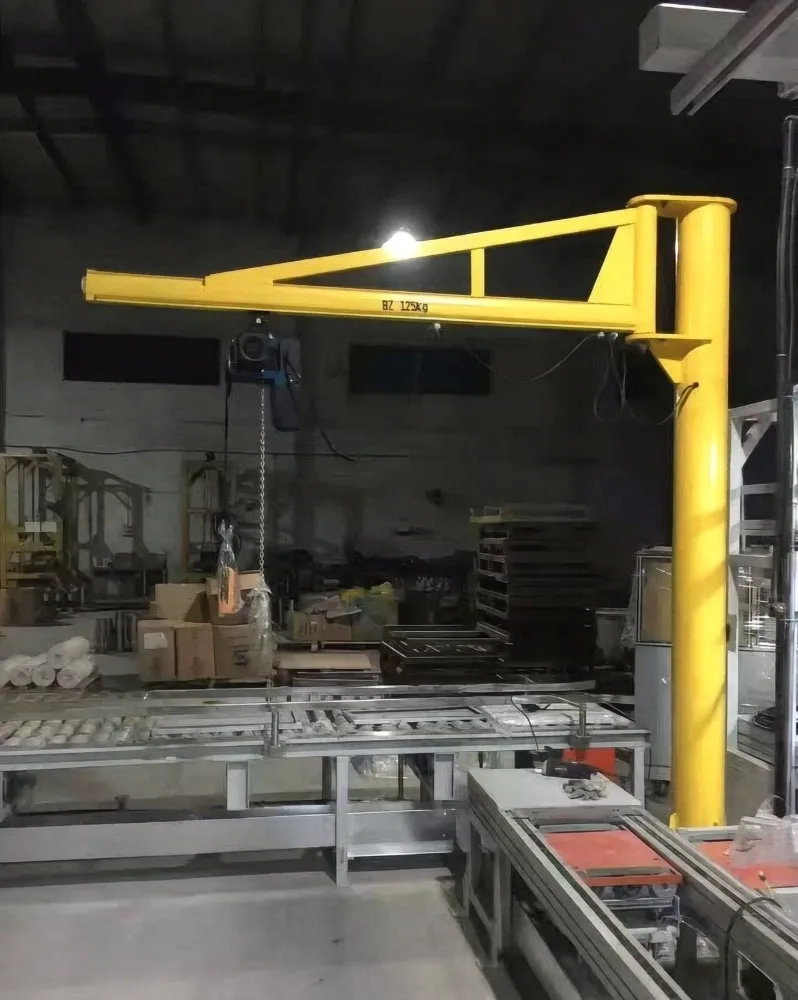
How Does a Jib Crane Rotate 360°? Slewing Mechanism Explained
A jib crane may look simple from the outside:
Column + boom + hoist
But one of the most important functions is actually the rotation of the boom.
How can the boom rotate around the column?
What allows it to carry a heavy load while rotating?
And does 360° rotation mean that the crane can rotate continuously without stopping?
The answer lies in the crane's slewing mechanism.
In this article, we explain how jib crane rotation works and what buyers should check before purchasing one.
How Does a Jib Crane Rotate?
The basic principle is simple.
The jib crane uses a slewing mechanism between the fixed column and the rotating boom.
The system allows the boom to rotate around the vertical axis while supporting the weight of the boom, hoist and suspended load.
Depending on the crane design, the rotation system may use:
- Slewing bearings
- Bearings and shafts
- Bushings
- Gear-driven slewing mechanisms
- Manual rotation
- Electric rotation
The exact design depends on the crane capacity, working radius, rotation range and operating frequency.
What Is a Jib Crane Slewing Bearing?
A slewing bearing can be thought of as a large bearing designed to support both rotational movement and significant loads.
In some jib crane designs, the slewing bearing connects the stationary structure with the rotating structure.
A typical slewing bearing may contain:
- Inner ring
- Outer ring
- Rolling elements
- Seals
- Mounting holes
- Gear teeth, if it is a geared type
The bearing allows the boom to rotate while transferring loads between the rotating and stationary structures.
However, not every jib crane uses exactly the same slewing bearing arrangement.
Smaller and simpler jib cranes may use other bearing or bushing configurations.
What Loads Does the Slewing System Carry?
The rotation system does more than simply allow the boom to turn.
It must operate while the crane is subjected to different loads.
These can include:
Vertical Load
The hoist and lifted load create a vertical load.
Radial Load
The crane structure can also experience forces acting horizontally relative to the rotation axis.
Overturning Moment
This is particularly important.
Imagine a 2-ton load suspended several meters away from the column.
The farther the load is from the column, the greater the overturning moment acting on the crane structure and slewing system.
That is why jib crane selection cannot be based only on:
"How many tons can it lift?"
You also need to consider:
Capacity + Working Radius + Duty Cycle
Manual vs Electric Jib Crane Rotation
There are two common ways to rotate a jib crane.
1. Manual Rotation
Manual jib cranes are commonly used for lighter loads and lower operating frequency.
The operator pushes the boom by hand.
If the rotation mechanism has low resistance and the crane is correctly installed, the boom can be relatively easy to move.
Typical applications include:
- Workstations
- Machine loading
- Small workshops
- Assembly areas
- Maintenance stations
Manual rotation has an important advantage:
Simple structure and low operating cost.
There is no rotation motor or gearbox required.
2. Electric Rotation
For heavier loads, longer booms or more frequent operation, electric rotation may be more appropriate.
A typical electric slewing system may include:
Electric motor → Gear reducer → Pinion → Slewing gear
The motor produces rotational power.
The gearbox reduces the speed and increases the available torque.
The pinion then engages with the gear teeth of the slewing mechanism.
This allows the boom to rotate under controlled power.
Why Use a Gear Reducer?
An electric motor normally rotates at a relatively high speed.
A jib crane does not need the boom to rotate at high speed.
Instead, it needs:
Low speed + controlled movement + sufficient torque
The gearbox therefore reduces the rotational speed and increases the available output torque.
This allows the boom to rotate more smoothly.
Can a Jib Crane Rotate 360°?
Yes, some jib crane designs can provide a 360° rotation range.
But there is an important distinction:
360° Rotation ≠ Unlimited Continuous Rotation
A crane described as having 360° rotation generally means that the boom can cover a full circular working range.
It does not automatically mean that the boom can continuously rotate hundreds of times in the same direction.
Why?
Because the crane may have:
- Power cables
- Control cables
- Air hoses
- Hydraulic hoses
- Other connections
Continuous rotation can cause these lines to twist or become damaged.
Therefore, the actual rotation arrangement needs to match the crane design and application.
Why Does a Jib Crane Need Rotation Limits?
This is one of the most important points for buyers.
A 360° jib crane should not simply be allowed to rotate without considering the surrounding installation.
Depending on the design, the crane may require:
- Rotation limit devices
- Mechanical stops
- Electrical limit switches
- Cable management
- Controlled rotation range
These components help prevent the boom from entering unsafe areas or damaging connected cables and hoses.
For example, imagine a crane installed next to a machine.
If the boom is allowed to rotate beyond the intended working area, it could:
- Hit the machine
- Hit a wall
- Enter a pedestrian area
- Pull a cable
- Damage an air hose
- Strike another crane
Therefore, the rotation range should be designed according to the actual workspace.
Mechanical Stop vs Rotation Limit
These two concepts are sometimes confused.
Mechanical Stop
A mechanical stop physically prevents the boom from rotating beyond a defined position.
It acts as a physical boundary.
Electrical Rotation Limit
An electrical limit device can send a signal to the control system to stop or restrict powered rotation.
For an electric jib crane, the actual safety arrangement should follow the crane's design and applicable requirements.
In some applications, both mechanical and electrical protection may be used.
Why Is Rotation Maintenance Important?
The slewing mechanism is a moving part.
Like any other mechanical component, it requires inspection and maintenance.
Common inspection points include:
Bolted Connections
Check whether critical mounting bolts are:
- Loose
- Damaged
- Corroded
- Missing
Bearings
Check for:
- Abnormal noise
- Excessive play
- Difficult rotation
- Vibration
- Lubrication problems
Gear Teeth
For geared slewing systems, inspect for:
- Abnormal wear
- Damage
- Poor lubrication
- Uneven contact
Mechanical Stops
Make sure the stop mechanism has not become loose or damaged.
Cables and Hoses
Check whether rotation is causing:
- Twisting
- Stretching
- Abrasion
- Cracking
- Excessive bending
How Often Should a Jib Crane Be Lubricated?
There is no single lubrication interval that applies to every jib crane.
The correct interval depends on:
- Bearing type
- Manufacturer's instructions
- Operating frequency
- Load
- Environment
- Temperature
- Dust and moisture
For this reason, don't simply use:
"Lubricate once every month."
as a universal rule.
Instead, follow the manufacturer's maintenance manual and use the specified lubricant and lubrication interval.
For dusty, humid or corrosive environments, maintenance requirements may be more demanding.
Does a Longer Jib Boom Make Rotation More Difficult?
It can.
A longer working radius can increase the overturning moment generated by the suspended load.
For example, a load positioned farther away from the column creates a greater moment.
That means the crane structure and slewing system must be designed according to:
- Rated capacity
- Working radius
- Boom length
- Duty cycle
- Foundation
- Structural configuration
This is why a:
1-ton × 2-meter jib crane
and a:
1-ton × 5-meter jib crane
should not automatically be treated as equivalent equipment.
The working radius matters.
Does a Heavier Load Always Make the Crane Harder to Rotate?
Not necessarily in the same way for every design.
The effect depends on:
- Load position
- Working radius
- Bearing design
- Slewing mechanism
- Crane structure
- Installation condition
A properly designed electric slewing mechanism can rotate a relatively heavy load in a controlled manner.
For a manual jib crane, however, increasing load and radius can increase the effort required from the operator.
This is one reason manual rotation is generally more suitable for lighter-duty applications.
What Should You Check When Buying a 360° Jib Crane?
Don't only ask:
"Can this jib crane rotate 360°?"
Ask these questions instead:
1. What is the actual rotation range?
Is it:
- 180°
- 270°
- 360°
- Limited by mechanical stops?
2. Is rotation manual or electric?
Choose according to load and operating frequency.
3. What type of slewing mechanism is used?
Ask whether the crane uses:
- Bearing
- Bushing
- Slewing bearing
- Gear-driven system
4. How is the rotation controlled?
For electric models, ask about:
- Motor
- Gearbox
- Control system
- Speed control
- Limit devices
5. How are cables protected?
This is particularly important for cranes with a large rotation range.
6. What is the required foundation?
The column and base must transfer the crane's loads safely into the foundation.
7. What is the working radius?
Do not specify the crane only by lifting capacity.
360° Jib Crane Selection Checklist
Before requesting a quotation, provide the supplier with:
Parameter | Example |
|---|---|
Lifting capacity | 1 ton |
Working radius | 4 m |
Lifting height | 3.5 m |
Rotation range | 360° |
Rotation type | Manual / Electric |
Working hours | 4 hours/day |
Lifting cycles | 20 cycles/hour |
Indoor / Outdoor | Indoor |
Environment | Normal / Dusty / Corrosive |
Power supply | 380 V / 50 Hz |
Foundation | Existing / New |
The more complete the information, the more accurately the supplier can select the crane.
Common Mistakes When Buying a 360° Jib Crane
Mistake 1: Only Looking at Lifting Capacity
A 2-ton crane is not fully defined by "2 tons."
You also need:
Radius + Height + Duty Cycle + Rotation Range
Mistake 2: Assuming 360° Means Unlimited Rotation
It doesn't necessarily.
Always confirm the actual rotation range and cable management arrangement.
Mistake 3: Ignoring the Foundation
A jib crane transfers significant forces into its foundation.
The foundation should be designed according to the crane's loads and installation conditions.
Mistake 4: Choosing Manual Rotation for Heavy, Frequent Work
Manual rotation may be fine for light workstation applications.
For frequent heavy-duty operation, powered rotation may provide better control and reduce operator effort.
Mistake 5: Forgetting the Surrounding Workspace
Before installation, check:
- Walls
- Machines
- Columns
- Walkways
- Doors
- Other cranes
- Storage areas
The boom needs sufficient clearance throughout its rotation range.
FAQ About Jib Crane 360° Rotation
How does a jib crane rotate?
A jib crane rotates through a slewing mechanism connecting the fixed column and rotating boom. Depending on the design, this may use bearings, bushings or a geared slewing system.
Can all jib cranes rotate 360°?
No.
Some jib cranes are designed for 180°, 270° or other limited rotation ranges. The required range should be specified during design.
Does 360° rotation mean continuous rotation?
Not necessarily.
A 360° rotation range means the boom can cover a full circular working area. It does not automatically mean unlimited continuous rotation.
Is manual or electric rotation better?
Manual rotation is generally suitable for lighter loads and lower operating frequency.
Electric rotation is more suitable when the crane is heavier, the boom is longer or the crane needs to rotate frequently.
What is a slewing bearing?
A slewing bearing is a large bearing designed to support loads while allowing relative rotation between the fixed and rotating structures.
Some designs also integrate gear teeth for powered rotation.
Why does a jib crane need a rotation limit?
Rotation limits can prevent the boom from entering unsafe areas and help protect cables, hoses, nearby equipment and structures.
How often should a jib crane slewing mechanism be lubricated?
There is no universal interval.
Follow the manufacturer's maintenance instructions and adjust maintenance according to operating frequency and environmental conditions.
Can a jib crane rotate under load?
A properly designed jib crane can be designed to rotate with its rated working load.
However, the crane must be operated according to its rated capacity, working radius and manufacturer's instructions.
Does a longer jib boom affect rotation?
Yes, a longer working radius can increase the overturning moment generated by the lifted load.
The complete crane structure and foundation therefore need to be designed for the required radius.
Final: The Secret Behind 360° Jib Crane Rotation
A jib crane's rotation may look simple, but several components work together.
The basic system can be understood as:
Column → Slewing mechanism → Boom → Hoist
For manual cranes, the operator moves the boom directly.
For electric cranes, the system may use:
Motor → Gearbox → Pinion → Slewing gear
But good rotation is not simply about making the boom turn.
A reliable jib crane should also have:
Smooth rotation + suitable load capacity + proper foundation + controlled rotation range + cable protection + regular maintenance
And remember:
360° rotation does not mean unlimited rotation.
Before purchasing a jib crane, confirm the actual rotation range, working radius, load capacity, duty cycle and safety arrangement with the supplier.
For overseas buyers in Southeast Asia and Africa, also provide the supplier with the local power supply, environmental conditions, foundation information and required working area.
The right jib crane is not the one that rotates the fastest.
It is the one that rotates smoothly, safely and reliably under the conditions you actually need.