Aug 21, 2026Crane Knowledge
Main Hook vs Auxiliary Hook: Why Heavy-Duty Overhead Cranes Need Two Hooks
Why do 32 ton and larger overhead cranes often use an auxiliary hook? Learn how main and auxiliary hooks handle heavy loads, light lifting and workpiece turning.
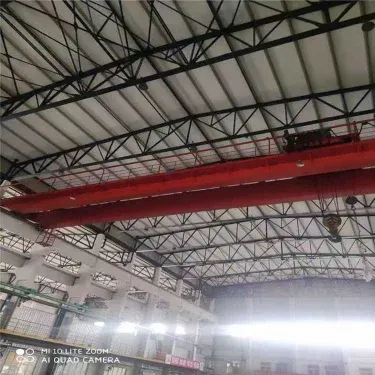
Why Do Heavy-Duty Overhead Cranes Have an Auxiliary Hook?
When selecting a 32 ton, 50 ton, 75 ton or larger overhead crane, some buyers focus only on the main lifting capacity.
But what if your factory needs to lift both:
- Heavy equipment weighing 30–50 tons
- Small components weighing only 3–10 tons
Using the main hook for every lifting task may not be the most efficient solution.
For heavy-duty applications with frequent light-load handling, adding an auxiliary hook can allow one overhead crane to handle both heavy and light lifting operations.
It can also assist with workpiece turning and positioning when the crane and lifting procedure are properly designed for the operation.
What Is an Auxiliary Hook on an Overhead Crane?
A heavy-duty double girder overhead crane can be equipped with two lifting mechanisms:
Main Hook: High lifting capacity for heavy loads
Auxiliary Hook: Lower lifting capacity for smaller loads and auxiliary operations
For example, a crane may be configured as:
- 32/5 ton
- 50/10 ton
- 75/20 ton
- 100/20 ton
The first number represents the main lifting capacity and the second represents the auxiliary lifting capacity.
For example:
50/10 Ton Overhead Crane
Main hook capacity: 50 tons
Auxiliary hook capacity: 10 tons
This means one crane can perform both heavy-duty and smaller lifting operations.
[Internal Link: Double Girder Overhead Crane]
Main Hook vs Auxiliary Hook
The two hooks are designed for different lifting requirements.
Item | Main Hook | Auxiliary Hook |
|---|---|---|
Lifting Capacity | Large | Smaller |
Typical Load | Heavy equipment | Small components |
Lifting Speed | Usually slower | Often faster |
Main Purpose | Heavy lifting | Light lifting & auxiliary work |
Workpiece Turning | Can work together when designed for it | Can assist |
Typical Capacity | 32t, 50t, 75t, 100t+ | 5t, 10t, 20t, etc. |
The exact capacity and speed should always be selected according to the actual working conditions.
Advantage 1: One Crane Handles Heavy and Light Loads
This is the biggest advantage of adding an auxiliary hook.
Imagine a heavy machinery factory using a 50 ton overhead crane.
Some days, the crane needs to lift:
- 40 ton machines
- 35 ton steel structures
- 30 ton molds
But during normal production, workers may also need to lift:
- 3 ton components
- 5 ton motors
- 8 ton machine parts
Using a 50 ton main hoist for every small component is unnecessary.
A 50/10 ton double girder overhead crane provides two lifting options:
50 ton main hook → heavy loads
10 ton auxiliary hook → smaller loads
One crane can therefore cover a wider range of production tasks.
Advantage 2: Faster Handling of Small Loads
Heavy-duty main hoists are designed primarily for lifting large loads safely and steadily.
Their lifting speed may therefore be relatively slow.
An auxiliary hoist has a smaller rated capacity and can often be configured with a higher lifting speed.
For frequent light-load handling, this can improve working efficiency.
Instead of operating the large main hoist every time a small component needs to be moved, operators can use the auxiliary hook.
This is particularly useful in:
- Heavy machinery factories
- Steel fabrication plants
- Mold manufacturing
- Equipment assembly workshops
- Power equipment manufacturing
- Large maintenance workshops
Advantage 3: It May Be More Economical Than Buying Another Crane
Suppose your factory needs:
Heavy lifting: up to 50 tons
Daily small-load lifting: 5–10 tons
One solution is:
50 ton overhead crane + separate 10 ton overhead crane
But this requires another complete crane system.
Another solution is:
50/10 ton overhead crane with main and auxiliary hooks
For suitable applications, adding an auxiliary lifting mechanism to the heavy-duty crane may be more economical than purchasing another complete small-capacity crane.
However, this should be evaluated according to operating frequency.
If heavy and light lifting operations need to take place simultaneously in different areas, two independent cranes may still provide better production efficiency.
Advantage 4: Auxiliary Hook for Workpiece Turning
Another important application is workpiece turning.
Large steel structures, molds, machine components and fabricated parts sometimes need to be rotated during production.
In a properly engineered lifting operation, the main hook and auxiliary hook can work together to help control the workpiece during turning.
For example:
Main hook → carries and controls the main load
Auxiliary hook → assists with rotation and positioning
This can provide better control than attempting to turn a large workpiece with only one lifting point.
However, load turning requires careful planning.
The crane capacity, hook positions, rigging, load center of gravity and forces on both hoists must all be checked before the operation.
The auxiliary hook should never be treated as a simple guarantee that any load can be safely turned.
[Internal Link: How to Turn Heavy Loads with an Overhead Crane]
How to Choose Auxiliary Hook Capacity
Common auxiliary hook capacities include:
- 5 tons
- 10 tons
- 16 tons
- 20 tons
But there is no fixed rule saying that a certain main hook capacity must use a certain auxiliary hook.
The correct selection depends on:
Weight of Small Loads
If most auxiliary loads are below 5 tons, a 5 ton auxiliary hook may be sufficient.
If your factory regularly handles 8–10 ton components, a 10 ton auxiliary hook may be more suitable.
Workpiece Turning Requirements
If the auxiliary hook will be used for load turning, its required capacity should be calculated according to the actual load, center of gravity, lifting points and turning process.
Lifting Frequency
If the auxiliary hook will be used frequently, its working duty and lifting speed become more important.
Required Lifting Speed
Factories that frequently handle small components may benefit from a faster auxiliary hoist.
Example: 50/10 Ton Double Girder Overhead Crane
Consider a heavy machinery workshop.
The factory needs to lift:
Maximum equipment weight: 45 tons
Daily component weight: 3–8 tons
Occasional requirement: Large workpiece turning
A 50/10 ton double girder overhead crane may be considered.
Main Hook – 50 Tons
Used for:
- Heavy machinery
- Large molds
- Steel structures
- Large equipment assembly
Auxiliary Hook – 10 Tons
Used for:
- Small components
- Motors
- Tools
- Assembly parts
- Auxiliary positioning
- Suitable workpiece turning operations
Instead of using the 50 ton hoist for every lifting task, operators can select the hook that matches the job.
When Should You Consider an Auxiliary Hook?
An auxiliary hook is worth considering when:
- Crane capacity is large
- Small loads are handled frequently
- The main hoist is too slow for routine light lifting
- Heavy and light loads are handled in the same working area
- Workpieces require controlled turning or positioning
- Buying another complete crane is unnecessary
For many 32 ton and larger heavy-duty overhead crane projects, it is worth discussing the auxiliary hook requirement during the design stage.
Adding it during the initial crane design is generally easier than discovering after installation that the production process requires another lifting mechanism.
When Is a Separate Small Crane Better?
An auxiliary hook is not always the best solution.
Suppose your factory needs the 50 ton crane to lift heavy equipment while another production line simultaneously needs a 5 ton crane.
One crane cannot efficiently serve two separate working areas at the same time.
In this situation:
50 ton crane + separate 5 ton crane
may provide better production efficiency than:
50/5 ton crane
Therefore, the choice depends not only on capacity but also on your production process.
What Information Should You Provide Before Selecting the Crane?
Before requesting a heavy-duty overhead crane quotation, provide:
Maximum lifting capacity: ___ tons
Normal daily load: ___ tons
Maximum load dimensions: ___
Crane span: ___ meters
Lifting height: ___ meters
Working hours per day: ___
Lifts per hour: ___
Need workpiece turning: Yes / No
Required auxiliary hook capacity: ___ tons
If you are unsure about auxiliary hook capacity, provide the weight, dimensions and lifting points of the workpiece so the lifting configuration can be evaluated.
FAQ
1. What is an auxiliary hook on an overhead crane?
An auxiliary hook is a secondary lifting mechanism installed on some heavy-duty overhead cranes. It normally has a smaller lifting capacity than the main hook and is used for lighter loads and auxiliary lifting operations.
2. Why is the auxiliary hook faster than the main hook?
The auxiliary hoist handles smaller loads and can often be designed with a higher lifting speed. The actual speed depends on the crane and hoist configuration.
3. Does every 32 ton overhead crane need an auxiliary hook?
No. An auxiliary hook should be selected according to actual production requirements. It is particularly useful when the same crane needs to handle both heavy and light loads.
4. What auxiliary hook capacity should I choose?
Common capacities include 5 tons, 10 tons, 16 tons and 20 tons. The correct capacity depends on your normal light loads, working frequency and whether the hook will assist with workpiece turning.
5. Can the main and auxiliary hooks be used to turn a workpiece?
They can be used together for certain engineered load-turning operations. However, the load weight, center of gravity, rigging, lifting points and forces on both hooks must be evaluated before lifting.
6. Is an auxiliary hook cheaper than buying another overhead crane?
For some applications, yes. If heavy and light lifting take place in the same working area and do not need to operate independently at the same time, adding an auxiliary hook can be more economical than installing another complete crane.
Conclusion
For a heavy-duty overhead crane, bigger lifting capacity does not mean the main hook should do every job.
If your workshop handles both heavy equipment and smaller components, a main hook + auxiliary hook configuration can make one crane much more flexible.
The main hook handles heavy loads.
The auxiliary hook handles smaller loads faster and can also assist with properly engineered workpiece turning operations.
For 32 ton, 50 ton, 75 ton and larger overhead crane projects, tell your crane supplier not only your maximum load, but also your normal daily lifting weight and whether you need workpiece turning.
Sometimes, choosing a 32/5 ton, 50/10 ton or 75/20 ton crane can be more practical than buying another complete small-capacity crane.