Aug 9, 2026Crane Knowledge
How Much Does An Overhead Crane Cost? Understanding Crane Price Breakdown
Why are overhead cranes expensive? Learn the main factors affecting crane prices, including steel structure, hoist components, manufacturing, transportation, installation and hidden costs.
How Much Does An Overhead Crane Cost? A Complete Breakdown Of Crane Pricing
Many customers think that overhead cranes are highly profitable products.
For example, some people believe:
"If a crane is sold for $10,000, the manufacturer may earn several thousand dollars."
However, the actual cost structure of an overhead crane is much more complicated.
A professional crane quotation includes many parts:
- Steel structure
- Hoisting equipment
- Electrical components
- Manufacturing process
- Transportation
- Installation
- After-sales service
Understanding these costs can help buyers compare quotations more accurately and avoid choosing the wrong crane only based on price.
What Determines The Price Of An Overhead Crane?
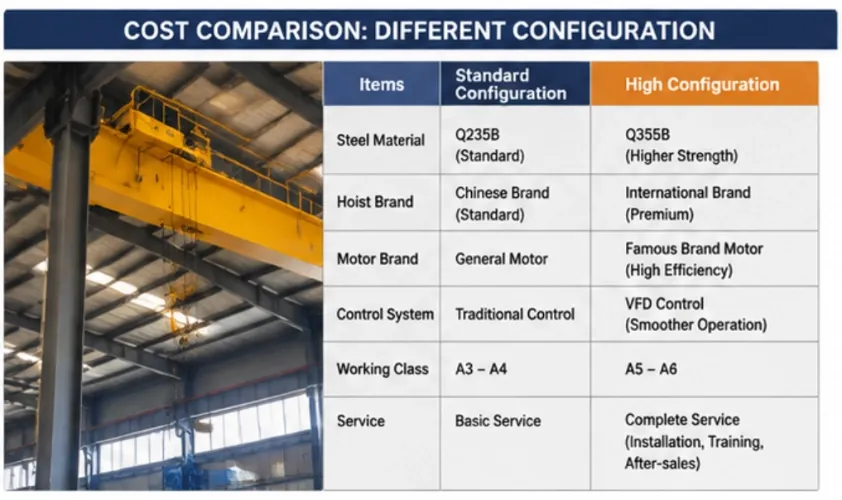
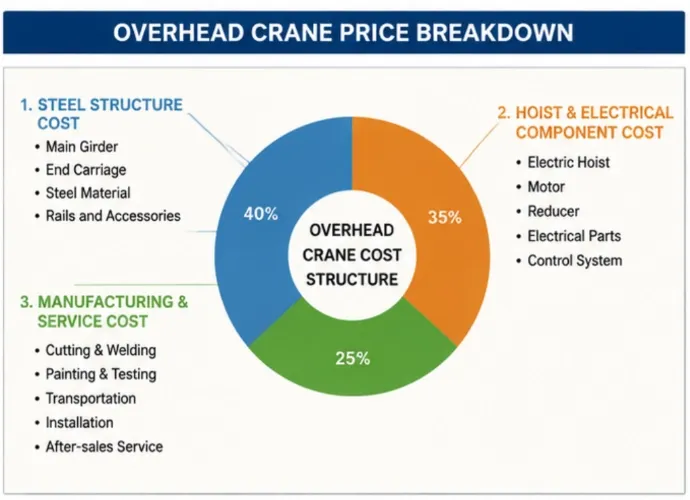
1. Steel Structure Cost: Main Girder And End Carriage
The steel structure is one of the biggest cost factors.
It mainly includes:
- Main girder
- End carriage
- Supporting steel structure
- Rails and accessories
The cost depends on:
Steel Material Quality
Different manufacturers may use different steel standards.
For example:
- Standard steel plate
- Higher strength steel
- Customized thickness requirements
The difference in material selection directly affects:
- Load capacity
- Crane lifespan
- Safety performance
Crane Design Standard
A crane designed according to international or national standards requires stricter:
- Structural calculation
- Welding requirements
- Inspection process
Lower-cost cranes may reduce material usage or simplify manufacturing processes, which can affect long-term reliability.
2. Hoist And Electrical Component Cost
The second major cost comes from the crane operating system.
Including:
- Electric hoist
- Motor
- Gear reducer
- Control panel
- Frequency converter
- Electrical protection devices
Different brands can create significant price differences.
For example:
A crane equipped with internationally recognized components usually costs more than one using standard local components.
The difference can range from several hundred to several thousand dollars depending on crane capacity and configuration.
3. Manufacturing, Transportation And Installation Cost
A complete crane is not only steel and components.
Behind every crane are many manufacturing processes:
Production Process:
- Steel cutting
- Welding
- Non-destructive testing
- Painting
- Assembly
- Factory testing
After production, additional costs include:
- Transportation
- Installation
- Commissioning
- Operator training
- After-sales support
For customers choosing a local crane supplier, transportation costs can often be reduced.
Local suppliers may also provide faster service when maintenance or troubleshooting is needed.
Hidden Costs That Customers Often Ignore
Many buyers only compare crane prices but forget additional project costs.
1. Factory Structure Modification
If the workshop does not have suitable crane support structures, additional work may be required.
For example:
- Steel columns
- Supporting beams
- Crane rails
- Foundation reinforcement
These costs can sometimes become a large part of the total investment.
2. Installation And Commissioning
A crane is not ready for operation after delivery.
Professional installation includes:
- Mechanical assembly
- Electrical connection
- Testing
- Safety inspection
Poor installation may lead to:
- Abnormal operation
- Faster wear
- Safety risks
Why Are Two Similar Crane Quotations Different?
Many customers receive different quotations for the same capacity crane.
For example:
Two suppliers both quote:
"10 ton overhead crane"
But the prices are different because the specifications may not be the same.
Differences may include:
Item | Lower Price Option | Higher Price Option |
|---|---|---|
Steel thickness | Standard | Reinforced |
Motor brand | General brand | Premium brand |
Control system | Traditional | Variable frequency drive |
Design standard | Basic | Advanced |
Service | Limited | Complete support |
Therefore, comparing only the total price is not enough.
How To Compare An Overhead Crane Quotation?
Before purchasing, check these points:
1. Confirm Technical Specifications
Including:
- Lifting capacity
- Span
- Lifting height
- Working class
- Working environment
2. Check Main Components
Ask:
- What steel material is used?
- Which hoist brand?
- Which motor brand?
- What electrical components are included?
3. Consider Total Project Cost
The cheapest crane is not always the lowest-cost solution.
A reliable crane with:
- Longer service life
- Lower maintenance cost
- Better after-sales support
may provide better long-term value.
FAQ
1. How much does an overhead crane cost?
The price depends on lifting capacity, span, lifting height, crane type, components, and installation requirements. Small workshop cranes may cost several thousand dollars, while heavy-duty industrial cranes can cost much more.
2. Why do overhead crane prices vary so much?
Because different suppliers may use different steel materials, components, manufacturing standards, and service packages.
3. What is the biggest cost of an overhead crane?
Usually, the largest costs come from the steel structure, hoisting system, and manufacturing process.
4. Should I choose the cheapest crane quotation?
Not necessarily. A lower price may mean different materials, fewer features, or limited service. Buyers should compare technical specifications instead of only price.
5. Does crane installation cost extra?
In many projects, transportation, installation, testing, and factory modifications are separate costs and should be included in the total budget.