Aug 11, 2026Buying Guide
Jib Crane Buying Guide: 3 Things More Important Than Lifting Capacity
Buying a jib crane? Learn why rotation, base stability, boom deflection and the boom-column connection matter more than lifting capacity alone.
Jib Crane Buying Guide: 3 Things More Important Than Lifting Capacity
When buying a jib crane, many customers ask the same question:
"How many tons can it lift?"
But that is only part of the story.
For a jib crane, the lifting capacity is mainly determined by the hoist and the overall crane design.
The more important question is:
Can the jib crane still rotate smoothly and operate reliably after months or years of use?
If the boom cannot rotate smoothly, or if the structure develops excessive movement or deflection, the crane becomes much less useful.
Before buying a jib crane, pay close attention to these 3 important areas.
What Is a Jib Crane?
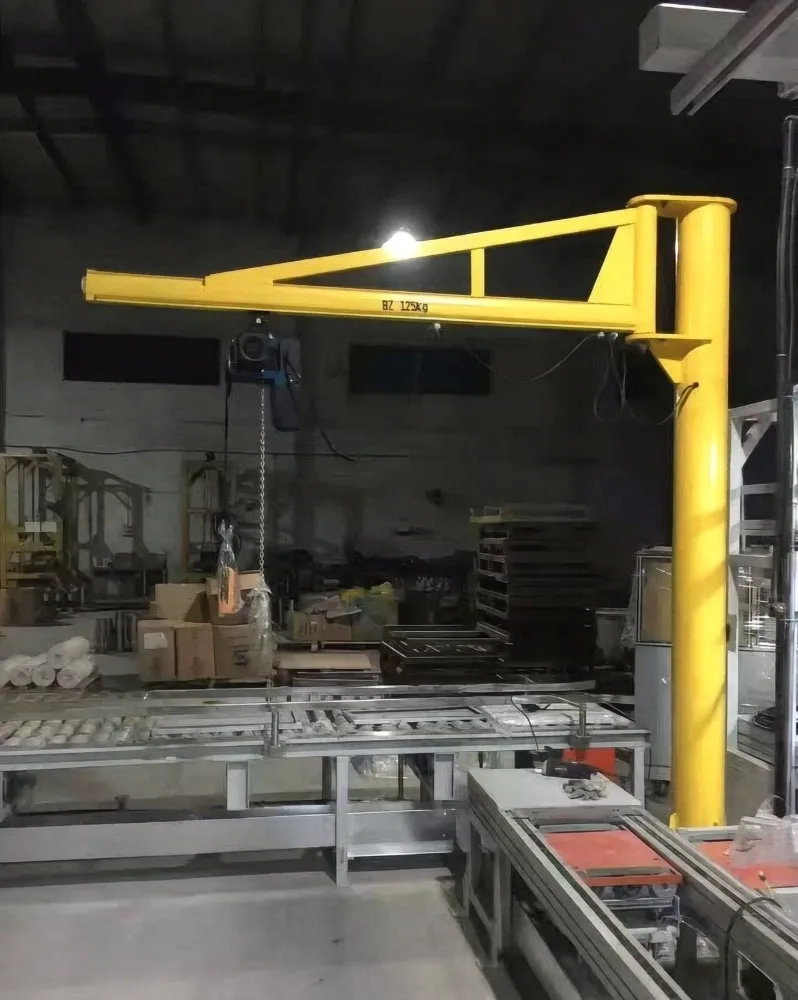
A jib crane is a compact lifting system consisting mainly of:
- Column
- Base plate or foundation
- Jib arm (boom)
- Slewing mechanism
- Hoist
- Trolley
- Electrical or manual controls
Compared with a large overhead crane, a jib crane is usually designed for localized lifting around a workstation.
Common applications include:
- Machinery workshops
- Welding areas
- Assembly lines
- Maintenance stations
- Warehouses
- Loading and unloading areas
- Production workstations
Its biggest advantage is flexibility.
The operator can lift a load and move it around the working area by rotating the jib arm.
That is why rotation is a critical part of the jib crane's performance.
1. Check the Jib Crane Base: Thickness Is Not Everything
Many buyers look at the base plate and think:
"The thicker the base, the stronger the crane."
This is not necessarily true.
The stability of a floor-mounted jib crane depends on the complete foundation and anchoring system.
Important factors include:
- Base plate dimensions
- Base plate thickness
- Concrete foundation strength
- Foundation thickness
- Anchor bolt arrangement
- Anchor bolt type
- Installation quality
- Crane capacity
- Working radius
- Maximum load
- Resulting overturning moment
A thick base plate cannot compensate for an inadequate foundation.
Why Is the Base So Important?
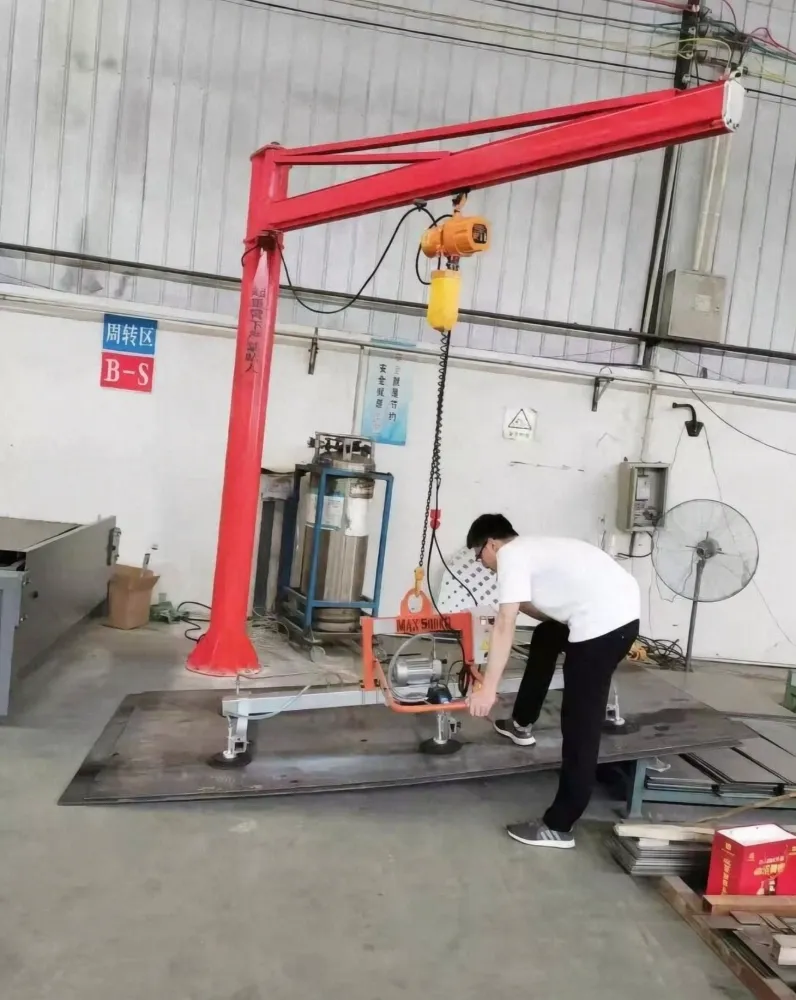
When the jib crane lifts a load, the boom creates a moment at the column base.
The heavier the load and the longer the working radius, the greater the forces transferred to the foundation.
This means a 1-ton load at a short radius can create very different structural requirements from a 1-ton load at a much longer radius.
Therefore, do not ask only:
"How thick is the base plate?"
Also ask:
"What foundation and anchoring requirements does this jib crane need?"
How Should a Jib Crane Be Anchored?
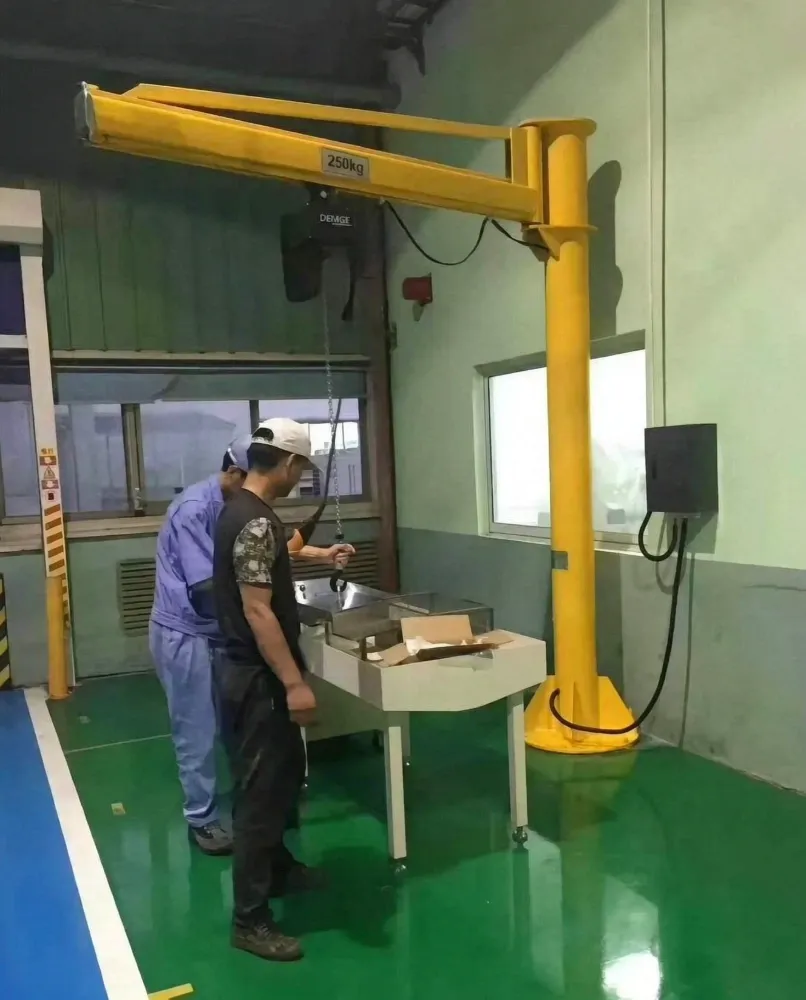
Floor-mounted jib cranes are commonly fixed to a concrete foundation using an appropriate anchoring system.
Depending on the design, this may involve:
- Anchor bolts
- Chemical anchors
- Expansion anchors
- Embedded foundation bolts
- A specially designed foundation
The correct method depends on the crane design and the existing concrete structure.
Before installation, check:
- Concrete strength
- Foundation thickness
- Reinforcement
- Anchor position
- Edge distance
- Anchor capacity
- Installation procedure
If the existing workshop floor is not suitable, simply adding more bolts does not automatically make the crane safer.
Foundation quality matters as much as the number of bolts.
2. Ask for the Jib Boom Deflection or Camber Data
The second important point is the jib boom itself.
A jib arm carries load and will experience some deformation under load.
This is a normal structural behavior.
The important question is:
How much deflection is expected under the design load?
A properly designed jib crane should have defined structural requirements for its boom.
Depending on the design, the manufacturer may provide information about:
- Boom deflection
- Structural deformation
- Initial camber
- Design load
- Maximum working radius
Why Does This Matter?
Imagine you purchase a new jib crane.
At first, the boom appears straight.
After months of operation, the boom develops noticeable permanent deformation.
The hook position may change.
The trolley may no longer move as expected.
The operator may notice unusual movement.
This is why buyers should not only ask:
"What is the lifting capacity?"
Ask:
"What is the boom design and allowable deflection under the rated load?"
The manufacturer should be able to provide appropriate technical information for the selected crane.
What Is Boom Camber?
Some jib crane designs may include an initial upward camber in the boom.
The purpose is to compensate, within the design, for expected deformation under load.
However, the amount of camber should not be guessed.
It depends on:
- Boom length
- Rated load
- Working radius
- Structural design
- Material
- Section geometry
- Design standard
Therefore, do not judge a jib crane only by looking at whether the boom is perfectly horizontal when unloaded.
Ask for the relevant engineering data instead.
3. Check the Column-to-Boom Connection
The third area is the connection between the column and jib boom.
This connection transfers important forces generated by the load and boom.
The design may use different connection methods depending on the type of jib crane.
For example:
- Welded connections
- Bolted connections
- Pin connections
- Bearing and slewing arrangements
- Special engineered connections
The important point is not simply:
"Which bolt looks bigger?"
The connection must be designed to safely transfer the required forces.
Ordinary Bolts vs. Precision-Fit Bolts
In some bolted structural connections, the type and fit of the bolt and hole are important.
A precision-fit or fitted bolt connection may be used where the design requires accurate load transfer through the connection.
The terminology can vary between standards and manufacturers.
Therefore, buyers should not assume that every jib crane must use one particular bolt type.
Instead, ask the manufacturer:
- What type of connection is used?
- How is shear transferred?
- What bolt grade is specified?
- What hole tolerance is required?
- What tightening method is required?
- Has the connection been structurally designed for the rated load and radius?
This is much more useful than simply counting the number of bolts.
Why Rotation Is So Important for a Jib Crane
A jib crane may lift a heavy load perfectly but still be inconvenient if the boom does not rotate smoothly.
For example, imagine a workshop where the operator needs to move a component from:
Machine → Assembly Table → Inspection Area
If the boom rotates smoothly, the load can be positioned quickly.
If the rotation system becomes stiff or develops excessive resistance, the operator may need more effort and more time to position the load.
Therefore, when evaluating a jib crane, consider:
- Slewing angle
- Manual or powered rotation
- Rotation resistance
- Bearing or slewing mechanism
- Brake system where applicable
- Structural alignment
- Maintenance requirements
The actual rotation system depends on the jib crane design.
Manual Jib Crane vs. Powered Jib Crane
Not every jib crane needs a powered rotation system.
Manual Rotation
Suitable for many light-duty workstation applications.
Advantages may include:
- Simple structure
- Lower cost
- Easy maintenance
- No additional rotation motor
The operator manually rotates the boom.
Powered Rotation
More suitable when:
- Loads are heavier
- Rotation frequency is high
- The working radius is large
- Precise positioning is required
- Manual rotation becomes difficult
Powered rotation can make repetitive operations easier.
The correct choice depends on the load, working frequency and required positioning accuracy.
3 Questions to Ask Before Buying a Jib Crane
Instead of immediately asking:
"How much is your jib crane?"
Ask these three questions first.
Question 1: What Are the Foundation Requirements?
Ask for:
- Base plate dimensions
- Anchor bolt requirements
- Concrete requirements
- Foundation requirements
- Installation drawing
Question 2: What Is the Boom Design Data?
Ask for:
- Rated load
- Working radius
- Boom length
- Deflection requirements
- Structural drawings where available
Question 3: How Is the Boom Supported and Connected?
Ask for:
- Connection type
- Bolt specifications
- Slewing arrangement
- Bearing information
- Installation requirements
If a supplier can clearly explain these technical points, you have much more useful information for comparing quotations.
Jib Crane Buying Checklist
Before placing an order, prepare the following information:
Parameter | What You Need to Confirm |
|---|---|
Capacity | Maximum lifting load |
Working radius | Maximum and minimum radius |
Lifting height | Required hook height |
Jib length | Required boom length |
Rotation | Manual or powered |
Slewing angle | 180°, 270°, 360° or other |
Hoist | Type and lifting speed |
Working class | Expected operating frequency |
Foundation | Concrete and anchoring requirements |
Environment | Indoor, outdoor, dust, humidity, etc. |
Power supply | Local electrical requirements |
Installation | Supplier or local installation team |
This information allows the supplier to design the jib crane around your actual application.
Common Jib Crane Buying Mistakes
Mistake 1: Only Comparing Lifting Capacity
Two jib cranes may both lift 1 ton but have very different:
- Boom lengths
- Working radii
- Foundation requirements
- Hoist configurations
- Working classes
- Rotation systems
Capacity alone is not enough.
Mistake 2: Choosing the Thickest Base
A thick base plate does not automatically mean a stable crane.
The complete foundation and anchoring system must be suitable for the crane loads.
Mistake 3: Ignoring Boom Deflection
A crane may look strong when it is new.
But long-term structural behavior matters.
Ask the supplier about the boom design and allowable deflection.
Mistake 4: Ignoring the Connection
The column-to-boom connection is an important structural area.
Ask how the connection transfers the required forces and what inspection or maintenance is required.
Mistake 5: Buying Only on Price
The cheapest jib crane may not be the cheapest solution over its service life.
Consider:
- Installation
- Maintenance
- Spare parts
- Downtime
- Operating efficiency
- Expected service life
A better comparison is:
Total cost of ownership, not only purchase price.
FAQ About Jib Cranes
What is the most important part of a jib crane?
There is no single "most important" component.
The hoist determines the lifting function, while the column, foundation, boom, connection and slewing system all contribute to the crane's safe operation.
For a workstation jib crane, smooth and reliable rotation is particularly important because it directly affects how the load is positioned.
Is a thicker jib crane base always better?
No.
Base thickness is only one design parameter.
Foundation strength, base dimensions, anchor arrangement, load, working radius and overturning forces must also be considered.
How do I know if my workshop floor can support a jib crane?
The existing concrete structure should be checked against the crane's foundation and anchoring requirements.
If necessary, a qualified structural engineer should assess the floor or foundation before installation.
What is jib crane boom deflection?
Boom deflection is the deformation of the jib arm under load.
Some deformation is expected in structural design, but it must remain within the applicable design limits.
Ask the supplier for the relevant technical information for your crane.
What type of bolt is used on a jib crane?
The connection type varies by design.
Some systems use structural bolts, while others may use fitted or precision-fit connections, pins or other engineered arrangements.
The manufacturer should specify the connection design and required bolt grade and installation procedure.
Should I choose a manual or powered jib crane?
Manual rotation can be suitable for lighter and less frequent applications.
Powered rotation may be more appropriate for heavier loads, frequent operation or applications requiring easier positioning.
The choice should be based on the actual working conditions.
Can a jib crane rotate 360 degrees?
Some jib crane designs can provide 360-degree rotation, while others are designed for a limited slewing angle.
The required rotation range should be specified when ordering.
How much weight can a jib crane lift?
Jib cranes are available in different capacities.
The correct capacity depends not only on the maximum load but also on the working radius, boom length, hoist configuration, duty cycle and structural design.
Final: When Buying a Jib Crane, Don't Only Ask "How Many Tons?"
The lifting capacity is important.
But it is not the whole story.
A good jib crane should be evaluated as a complete system:
Foundation + Column + Boom + Connection + Slewing System + Hoist
Before comparing prices, ask the supplier about these three areas:
1. Foundation and anchoring requirements
2. Boom structural data and allowable deflection
3. Column-to-boom connection design
Then look at the price.
A jib crane that looks cheap on the quotation may become expensive if it causes installation problems, excessive maintenance or production downtime.
The best jib crane is not simply the one with the largest hoist.
It is the one that can safely lift, smoothly rotate and reliably perform the job for which it was designed.