Aug 14, 2026Industry Solutions
Rail-Less Gantry Crane: 3 Advantages You Should Know
Learn the main advantages of rail-less gantry cranes, including no fixed rails, flexible movement and faster deployment for factories and outdoor yards.
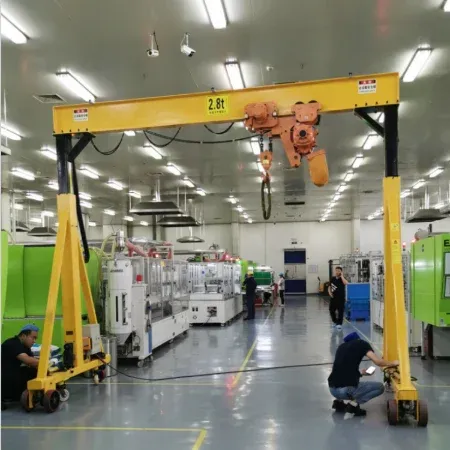
Rail-Less Gantry Crane: 3 Advantages You Should Know
Traditional gantry cranes usually travel along fixed rails.
But what happens when your factory does not have a fixed material handling route?
What if production areas change frequently?
What if you need to move the crane from one work area to another?
This is where a rail-less gantry crane can be useful.
A rail-less gantry crane is designed to move without a fixed runway rail system. Depending on the design, it can travel across a prepared floor and provide more flexibility than a conventional rail-mounted gantry crane.
For factories and outdoor yards, three advantages are particularly important:
No fixed rails.
Flexible movement.
Fast deployment.
Let's look at each one.
What Is a Rail-Less Gantry Crane?
A rail-less gantry crane is a mobile gantry crane that does not rely on a permanent rail track for normal movement.
Instead, the crane travels on its own wheel or drive system across a prepared working surface.
Depending on the design, the system may support different movement modes, such as:
- Forward movement
- Reverse movement
- Steering
- Turning
- Lateral movement
- Diagonal movement
Some configurations can also provide a large turning radius or near in-place turning.
The exact movement capability depends on the wheel arrangement, steering system and drive design.
This gives the crane greater flexibility when compared with a fixed rail system.
Advantage 1: No Fixed Crane Rails Required
The first advantage is obvious:
You do not need a permanent runway rail for normal crane travel.
A traditional rail-mounted gantry crane normally requires:
- Rails
- Rail foundations
- Embedded components
- Rail alignment
- Drainage considerations
- Regular rail maintenance
These requirements can increase the project scope, especially when the customer does not already have suitable crane rails.
A rail-less gantry crane can eliminate the need for a permanent travel rail system.
However, this does not mean that the crane can operate on any floor.
The ground must still be suitable for the crane.
Important factors include:
- Ground bearing capacity
- Floor thickness
- Surface flatness
- Wheel load
- Total crane weight
- Working load
- Outdoor drainage
- Cracks or uneven surfaces
Before installation, the supplier should confirm whether the existing concrete floor is suitable.
Why Can Rail-Less Gantry Cranes Be Easier to Install?
A rail-mounted crane may require construction work before the crane can operate.
For example:
Ground preparation → Rail foundation → Rail installation → Alignment → Crane installation
A rail-less system can reduce this infrastructure requirement.
A typical project may instead focus on:
Ground assessment → Crane assembly → System commissioning → Operation
This can make the deployment process faster.
The actual installation time depends on the crane size, configuration and site conditions.
For factories with an existing concrete floor, this can be particularly attractive.
Advantage 2: High Mobility and Flexible Movement
The second major advantage is mobility.
A rail-mounted gantry crane is restricted by its rail route.
Once the rails are installed, the crane normally travels along that predefined path.
A rail-less gantry crane can provide much greater flexibility.
Depending on the configuration, it may be able to:
- Turn
- Change direction
- Move between work areas
- Travel diagonally
- Relocate to another production area
Some systems can also perform very small-radius or near in-place turning.
This is useful when production layouts change frequently.
Why Is Mobility Important in a Factory?
Imagine a factory that has three production areas:
Area A → Area B → Area C
Today, the main lifting requirement is in Area A.
Next month, production moves to Area C.
A rail-mounted crane cannot easily change its travel route after installation.
A rail-less crane may be able to move to another work area, depending on floor conditions and its steering system.
This can reduce the need to build a new crane route every time the production layout changes.
Rail-Less Crane for Flexible Production
Rail-less gantry cranes can be useful in applications where the lifting location changes frequently.
For example:
- Equipment assembly
- Machinery manufacturing
- Outdoor material yards
- Maintenance areas
- Steel storage
- Precast concrete production
- Temporary production areas
- Construction-related material handling
The common feature is:
The lifting point is not always fixed.
This is where mobility becomes a major advantage.
Can a Rail-Less Gantry Crane Move Diagonally?
Some designs can support steering and movement at different angles.
Depending on the wheel and steering configuration, the crane may be able to move:
Forward → Turn → Sideways → Diagonal
This can be especially useful in crowded factories.
However, diagonal movement is not a universal feature of every mobile gantry crane.
Before purchasing, confirm the exact steering and driving functions with the supplier.
Can a Rail-Less Gantry Crane Rotate in Place?
Some specially configured mobile gantry cranes can achieve a very small turning radius or near in-place rotation.
This can be useful when workshop space is limited.
But again, this depends on:
- Wheel arrangement
- Steering system
- Drive system
- Control method
- Crane dimensions
- Floor condition
Therefore, do not assume every rail-less gantry crane can perform a full 360° in-place rotation.
Ask the supplier for the actual movement specification.
Advantage 3: Faster Deployment
The third advantage is shorter infrastructure preparation.
This matters to factories that want to start production quickly.
Traditional fixed crane systems may require construction work before operation.
A mobile rail-less system can reduce some of these preparations.
This can be particularly useful for:
- New production lines
- Temporary workshops
- Factory expansion
- Rental production sites
- Outdoor material yards
- Projects with changing layouts
The crane can potentially be assembled and commissioned without building a permanent travel rail system.
This provides greater flexibility during the early stage of a project.
Rail-Less Gantry Crane vs Rail-Mounted Gantry Crane
The difference can be summarized simply:
Feature | Rail-Less Gantry Crane | Rail-Mounted Gantry Crane |
|---|---|---|
Fixed rails | Not required for normal travel | Required |
Rail foundation | Usually not required | Required |
Mobility | High | Limited to rail route |
Layout flexibility | High | Lower |
Deployment | Potentially faster | More infrastructure work |
Floor requirements | Important | Rail foundation is important |
Direction changes | Possible depending on design | Generally limited |
Long-term fixed route | Less necessary | Excellent |
High-frequency fixed operation | Application dependent | Often suitable |
Neither system is automatically better.
The right choice depends on the factory layout and lifting requirements.
When Should You Choose a Rail-Less Gantry Crane?
A rail-less gantry crane may be worth considering when:
1. Your Production Layout Changes Frequently
Your workstations are not permanently fixed.
2. You Do Not Want to Build Permanent Rails
You want to avoid extensive rail foundation work.
3. The Crane Needs to Move Between Different Areas
The lifting position changes according to production requirements.
4. You Need Fast Deployment
You want to reduce infrastructure preparation before the crane enters service.
5. You Operate in an Outdoor Yard
You need flexible movement across a prepared working area.
6. You Want One Crane to Serve Multiple Work Areas
Instead of installing separate fixed lifting systems, one mobile crane may serve different zones when properly designed.
When Is a Rail-Less Gantry Crane Not the Best Choice?
A rail-less crane is not suitable for every application.
A rail-mounted gantry crane may be a better solution when:
- The travel route is fixed
- Crane movement is very frequent
- High positioning accuracy is required
- The crane needs to operate continuously along one route
- Ground conditions are poor
- Floor flatness is insufficient
- Very heavy loads require specialized wheel and foundation design
The decision should be based on the actual application rather than simply choosing the more flexible system.
Ground Conditions Are Very Important
One common misunderstanding is:
"No rails means I can use it on any concrete floor."
Not necessarily.
A rail-less gantry crane still transfers significant wheel loads to the ground.
Before operation, check:
- Concrete strength
- Floor thickness
- Surface flatness
- Ground bearing capacity
- Cracks
- Uneven areas
- Drainage
- Obstacles
- Slope
For outdoor use, also consider:
- Rain
- Mud
- Water accumulation
- Temperature
- Dust
- Surface deterioration
A mobile crane can only perform properly when the working surface is suitable for its wheel loads and movement system.
What About Outdoor Use?
Rail-less gantry cranes can be attractive for outdoor applications because they are not tied to one fixed rail route.
They may be used in:
- Steel yards
- Machinery yards
- Construction material yards
- Precast concrete plants
- Maintenance areas
- Temporary lifting zones
However, outdoor operation creates additional considerations.
These include:
Wind + Rain + Ground + Corrosion + Visibility
Wind is particularly important for gantry cranes.
For outdoor operation, the crane should be designed according to the local wind conditions and include appropriate parking and anti-wind measures where required.
How Much Load Can a Rail-Less Gantry Crane Lift?
There is no single capacity for all rail-less gantry cranes.
Capacity depends on the:
- Crane structure
- Wheel arrangement
- Drive system
- Foundation or floor
- Span
- Lifting height
- Working frequency
- Load spectrum
Therefore, do not choose a crane by capacity alone.
A better specification is:
Capacity + Span + Height + Duty Cycle + Ground Condition + Movement Requirements
How to Choose a Rail-Less Gantry Crane
Before asking for a quotation, prepare these parameters.
Lifting Capacity
What is the maximum load?
Span
How wide is the required lifting area?
Lifting Height
How high must the hook reach?
Working Area
How large is the area the crane needs to cover?
Floor Condition
What is the concrete thickness and bearing capacity?
Movement
Do you need:
- Forward/reverse
- Steering
- Side movement
- Diagonal movement
- Small-radius turning
Working Frequency
How many hours per day will the crane operate?
Indoor or Outdoor
Outdoor applications require additional consideration for wind and weather.
Rail-Less Gantry Crane Buying Checklist
Use these questions when comparing suppliers:
Question | What to Confirm |
|---|---|
Does it need rails? | No fixed rail / specific configuration |
Floor requirement | Concrete strength and thickness |
Maximum wheel load | ______ |
Maximum lifting capacity | ______ |
Span | ______ |
Lifting height | ______ |
Steering system | ______ |
Turning radius | ______ |
Travel speed | ______ |
Working environment | Indoor / Outdoor |
Wind condition | ______ |
Power supply | ______ |
Safety system | ______ |
Maintenance | ______ |
This gives you a much better basis for comparing different mobile gantry crane suppliers.
FAQ About Rail-Less Gantry Cranes
What is a rail-less gantry crane?
A rail-less gantry crane is a mobile gantry crane designed to move without relying on a permanent rail track for normal travel.
It uses a wheel, steering and drive system to move across a prepared working surface.
Does a rail-less gantry crane need a rail foundation?
A permanent travel rail foundation is generally not required.
However, the crane still needs a suitable ground or concrete surface capable of supporting the wheel loads.
Can a rail-less gantry crane move sideways?
Some configurations support lateral or multi-directional movement.
The exact capability depends on the wheel and steering system.
Can a rail-less gantry crane rotate 360°?
Some specialized designs can provide near in-place turning or a very small turning radius.
But this is not a universal feature.
Confirm the actual movement capability with the manufacturer.
Is a rail-less gantry crane suitable for outdoor use?
Yes, it can be used outdoors when properly designed.
Wind, rain, ground conditions, corrosion and parking safety must be considered.
Is a rail-less gantry crane better than a rail-mounted gantry crane?
Not always.
A rail-less crane is more flexible, while a rail-mounted crane can be better for fixed and repetitive travel routes.
The correct choice depends on the application.
What floor does a rail-less gantry crane need?
It needs a suitable, sufficiently strong and reasonably level surface.
The exact requirement depends on crane weight, wheel load, load capacity and travel configuration.
Is a rail-less gantry crane faster to install?
It can reduce infrastructure preparation because a permanent rail system may not be required.
Actual deployment time depends on the crane size, assembly method and site conditions.
Can one rail-less gantry crane serve several work areas?
Yes, this is one of its main potential advantages.
If the floor and operating environment are suitable, the crane can be moved between different working zones.
Final: When Flexibility Matters, Consider a Rail-Less Gantry Crane
A conventional gantry crane is a good choice when you have:
A fixed route + fixed production area + frequent repetitive lifting
A rail-less gantry crane becomes more attractive when you need:
Flexible movement + changing work areas + faster deployment
Its three main advantages are:
1. No Permanent Rails
You can avoid a fixed crane rail system, while still requiring a suitable supporting floor.
2. High Mobility
Depending on the configuration, the crane can change direction and move between different working areas.
3. Faster Deployment
Less permanent infrastructure can make the crane easier to deploy when production requirements change.
But remember:
No rails does not mean no ground requirements.
Before purchasing, confirm:
Capacity + Span + Lifting Height + Wheel Load + Floor Condition + Movement Requirements
Then select the crane according to the actual application.
The best mobile gantry crane is not simply the one that moves the most. It is the one that can move safely and efficiently where your production actually needs it.