Aug 12, 2026Buying Guide
Types of Gantry Cranes: How to Choose the Right Structure
Compare full truss, full box girder and box girder with truss legs gantry cranes. Learn which gantry crane structure is suitable for your application
Types of Gantry Cranes: How to Choose the Right Structure
When buying a gantry crane, many customers know the required lifting capacity and span, but they are not sure which gantry crane structure is right for their application.
Should you choose:
- A full truss gantry crane?
- A full box girder gantry crane?
- A box girder girder with truss legs?
The answer depends on more than lifting capacity.
You should also consider:
- Outdoor or indoor operation
- Wind conditions
- Lifting frequency
- Load requirements
- Span and overall height
- Ground conditions
- Transportation and installation
- Long-term operating environment
This guide compares three common gantry crane structural configurations and explains where each one may be suitable.
What Are the Main Types of Gantry Crane Structures?
For many industrial applications, gantry cranes can be designed with different main girder and leg configurations.
Three common options are:
- Full Truss Gantry Crane
- Full Box Girder Gantry Crane
- Box Girder Main Beam with Truss Legs
They have different characteristics in terms of structural weight, stiffness, wind resistance and application.
There is no single structure that is best for every factory.
1. Full Truss Gantry Crane
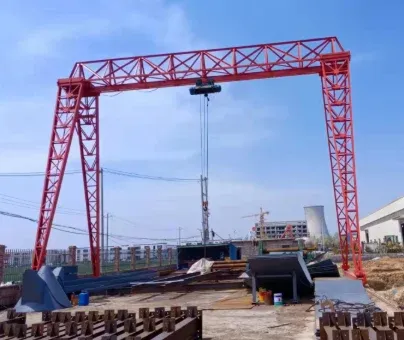
A full truss gantry crane uses a truss-style structure for the main girder and supporting legs.
Its main characteristic is a relatively open structural design.
Advantages
A truss structure can provide:
- Lower structural weight
- Efficient use of steel
- Open construction
- Convenient transportation in some applications
- Reduced wind-exposed solid surface compared with a fully enclosed structure
This can make a full truss gantry crane worth considering for certain outdoor applications.
Where Is It Suitable?
It can be considered for:
- Outdoor material yards
- Construction material handling
- Precast concrete yards
- Steel storage areas
- Open industrial yards
- Applications where wind exposure is an important design consideration
However, wind resistance should not be judged only by whether the crane uses a truss structure.
The complete crane must be designed according to:
- Local wind speed
- Crane height
- Span
- Self-weight
- Leg structure
- Wheel loads
- Rail or ground conditions
- Anchoring requirements
For coastal areas or regions with strong seasonal winds, wind load should be discussed with the crane engineer before selecting the structure.
2. Full Box Girder Gantry Crane
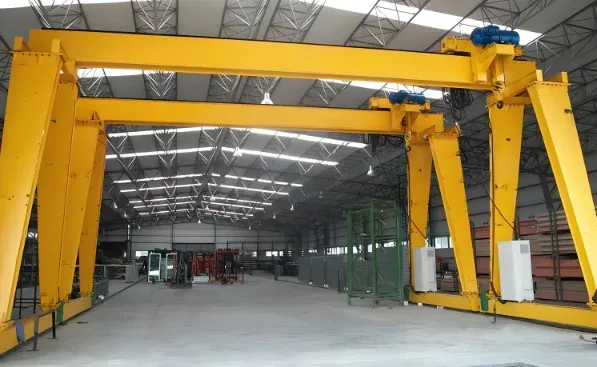
A full box girder gantry crane uses box-shaped structures for the main girder and supporting legs.
Compared with an open truss structure, a box girder provides a more enclosed and rigid structural arrangement.
Main Advantage: Structural Stiffness
For heavy-duty applications, structural stiffness is an important consideration.
A properly designed box girder structure can provide strong resistance to:
- Bending
- Torsion
- Repeated loading
This makes it suitable for applications where the crane operates frequently and handles relatively heavy loads.
Typical Applications
Full box girder gantry cranes may be considered for:
- Heavy machinery factories
- Steel processing plants
- Precast concrete plants
- Heavy fabrication yards
- Large material storage yards
- Heavy-duty outdoor lifting
For applications involving frequent heavy lifting, the complete crane should be selected according to the required duty class and load spectrum, not simply the maximum lifting capacity.
A 20-ton crane used occasionally is very different from a 20-ton crane operating continuously throughout the working day.
3. Box Girder Main Beam + Truss Legs
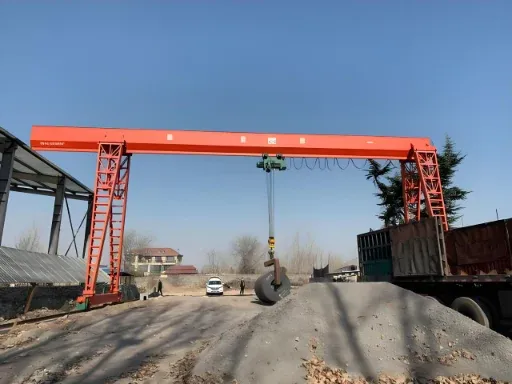
This configuration combines two structural approaches.
The main girder uses a:
Box girder structure
while the supporting legs use:
Truss structures
This provides a balance between structural stiffness and relatively open supporting legs.
Why Choose This Design?
The box girder main beam provides a rigid load-carrying structure.
The truss legs can provide:
- Lower structural weight
- Open construction
- Reduced material in some designs
- Practical support for certain outdoor applications
As a result, this configuration can be a practical option when the customer wants a balance between structural rigidity and overall weight.
Typical Applications
It may be suitable for:
- Outdoor factories
- Steel processing yards
- Precast concrete plants
- Material storage areas
- Machinery manufacturing
- General industrial lifting
The actual suitability still depends on the crane's engineering parameters.
Full Truss vs. Full Box vs. Box + Truss
Here is a simple comparison:
Feature | Full Truss | Full Box Girder | Box Girder + Truss Legs |
|---|---|---|---|
Main structure | Truss | Box girder | Box girder |
Legs | Truss | Box girder | Truss |
Structural weight | Often lower | Usually heavier | Intermediate |
Structural stiffness | Moderate to high, depending on design | High | High main girder stiffness |
Open structure | Yes | No | Partly open |
Wind exposure | Can be advantageous | Requires careful wind-load design | Can be advantageous |
Heavy-duty use | Application dependent | Strong option | Application dependent |
Outdoor use | Common | Common | Common |
Transportation | Can be convenient | May require sectionalization | Depends on design |
This is a general comparison.
The actual performance of a gantry crane depends on the complete engineering design rather than the structural category alone.
Which Gantry Crane Structure Should You Choose?
Instead of asking:
"Which structure is the best?"
Ask:
"Which structure is best for my working conditions?"
Here are some simple scenarios.
Scenario 1: Outdoor Yard With Strong Wind
If your gantry crane will operate outdoors in an area with strong wind, wind load should be one of the first design considerations.
A truss-style structure may reduce the solid surface exposed to wind compared with a fully enclosed structure.
But the crane still needs proper:
- Wind-load calculation
- Rail design
- Wheel and travel system
- Anchoring
- Storm protection
- Parking arrangements
For outdoor gantry cranes, wind protection is not optional.
Scenario 2: Heavy Loads and Frequent Operation
If the crane handles heavy loads every day and operates frequently, structural stiffness and fatigue performance become more important.
A full box girder design may be worth considering.
However, the crane should also be selected according to the required duty class.
For example, you should provide information about:
- Maximum load
- Average load
- Lifting cycles per hour
- Working hours per day
- Working days per year
This allows the manufacturer to select an appropriate crane duty class.
Scenario 3: You Want a Balance Between Weight and Rigidity
If you need a relatively rigid main girder but do not want a fully enclosed support structure, the box girder main beam + truss legs configuration can be considered.
This is often a practical compromise between:
Structural stiffness + structural weight + outdoor adaptability
The final configuration should still be confirmed by the crane manufacturer based on the project conditions.
Does a Truss Gantry Crane Have Better Wind Resistance?
This is a common question.
The answer is:
It can have advantages, but structure type alone does not determine wind resistance.
Wind load depends on several factors, including:
- Crane height
- Span
- Structural surface area
- Local design wind speed
- Crane self-weight
- Location
- Wind exposure
- Rail system
- Anchoring system
A tall crane installed in an exposed coastal area can experience very different wind loads from a low crane installed inside a protected industrial yard.
Therefore, when buying an outdoor gantry crane, provide the supplier with the actual project location and site conditions.
Does a Box Girder Gantry Crane Have Better Stability?
A properly designed box girder can provide high structural stiffness.
However, overall crane stability depends on the complete system.
Important factors include:
- Main girder design
- Leg design
- Crane width
- Wheelbase
- Self-weight
- Load position
- Ground conditions
- Rail alignment
- Wind load
- Anchoring
Therefore:
Box girder does not automatically mean "more stable" in every situation.
The complete crane must be engineered for the intended working conditions.
What About Crane Span?
Span is another important factor when selecting the structure.
As span increases, the structural design becomes more demanding.
The manufacturer needs to consider:
- Main girder deflection
- Structural strength
- Torsional stiffness
- Self-weight
- Wheel loads
- Transportation requirements
For a very long-span gantry crane, the main girder may also need to be divided into transportable sections.
You can learn more about this topic in our guide on why overhead crane girders are divided into sections for transportation.
What About Crane Working Class?
Do not select a gantry crane based only on:
"I need a 10-ton crane."
Two 10-ton cranes can have completely different working conditions.
For example:
Crane A
10-ton capacity
Used 1–2 hours per day
Occasional lifting
Crane B
10-ton capacity
Used 8–10 hours per day
Frequent lifting
High number of lifting cycles
These two cranes may require different duty classifications and component selections.
Before ordering, calculate your actual operating conditions.
How to Choose a Gantry Crane: 7 Parameters to Prepare
Before requesting a quotation, prepare these seven parameters:
1. Lifting Capacity
How heavy is the maximum load?
2. Span
What is the distance between the crane legs or rails?
3. Lifting Height
How high does the hook need to reach?
4. Working Frequency
How many hours per day will the crane operate?
5. Load Spectrum
Will the crane frequently lift close to its maximum rated load?
6. Working Environment
Indoor or outdoor?
Is the area dusty, humid, coastal or exposed to strong wind?
7. Ground and Rail Conditions
Will the crane run on existing rails or a new foundation?
Providing these details allows the supplier to recommend the appropriate structure rather than simply offering the cheapest model.
Gantry Crane Structure Selection Checklist
Use this simple checklist before making a decision:
Question | Your Requirement |
|---|---|
Indoor or outdoor? | ______ |
Maximum lifting capacity | ______ |
Span | ______ |
Lifting height | ______ |
Working hours/day | ______ |
Lifting cycles/hour | ______ |
Maximum load frequency | ______ |
Local wind conditions | ______ |
Ground/rail condition | ______ |
Power supply | ______ |
Required rotation/travel speed | ______ |
Once these parameters are clear, structural selection becomes much easier.
FAQ About Gantry Crane Structures
What are the main types of gantry crane structures?
Three common configurations are full truss, full box girder, and box girder main beam with truss legs.
The best choice depends on the application.
Which gantry crane is best for outdoor use?
Several gantry crane structures can be used outdoors.
For outdoor applications, wind load, corrosion protection, rain, temperature, ground conditions and storm parking requirements should all be considered.
Is a truss gantry crane better in strong wind?
A truss structure can have less solid surface exposed to wind than a fully enclosed structure.
However, wind resistance depends on the complete crane design, including height, span, self-weight, wind speed, anchoring and rail conditions.
Which gantry crane is best for heavy loads?
A box girder gantry crane can be a strong option for heavy-duty applications because of its structural stiffness.
However, the final choice should be based on load spectrum, duty class, span, lifting height and operating frequency.
What is a box girder gantry crane?
A box girder gantry crane uses box-shaped structural members for the main girder and/or legs.
It is commonly considered where structural stiffness and heavy-duty performance are important.
What is a truss gantry crane?
A truss gantry crane uses an open truss structure made from interconnected steel members.
It can provide an efficient structural design and may be useful for certain outdoor applications.
What is a box girder gantry crane with truss legs?
It combines a box girder main beam with open truss-style supporting legs.
This configuration can provide a balance between main girder stiffness and relatively lightweight supporting structures.
Can a gantry crane be used in Africa or Southeast Asia?
Yes.
Gantry cranes are widely applicable to industrial yards, steel fabrication, precast concrete, warehouses and other material-handling applications.
However, the crane should be designed according to the local climate, wind conditions, power supply, foundation and applicable safety requirements.
Final: Choose the Structure According to the Site
There is no single gantry crane structure that is best for every project.
A simple way to think about the three configurations is:
Full Truss
Lightweight + open structure + potentially advantageous for wind exposure
Consider it for suitable outdoor applications where structural weight and wind exposure are important.
Full Box Girder
High structural stiffness + heavy-duty applications
Consider it when frequent and heavy lifting requires a rigid structural design.
Box Girder + Truss Legs
Balance between rigidity + structural weight + outdoor adaptability
Consider it when you want a rigid main girder while keeping the supporting legs relatively open.
But don't choose a gantry crane simply because one structure "looks stronger."
Give the manufacturer your:
Capacity + Span + Lifting Height + Working Class + Wind Conditions + Ground Conditions
Then select the structure according to the actual application.
The right gantry crane is not the biggest or heaviest one. It is the one properly designed for your working conditions.