Aug 22, 2026Buying Guide
VFD Crane vs Traditional Crane: Benefits of Variable Frequency Control
What is the difference between a VFD crane and a traditional overhead crane? Learn how VFD control improves lifting, trolley travel, crane travel, load stability and equipment life.
VFD Crane vs Traditional Crane: What Is the Difference?
Why do more modern overhead cranes use VFD (Variable Frequency Drive) control?
To understand the advantages, we first need to understand the limitations of conventional crane control.
Traditional cranes may use direct starting, contactor-based control or resistance speed control depending on their design.
In many older crane systems, the available speeds are limited.
The crane may start relatively quickly, travel at a fixed speed and then brake quickly when the operator releases the control.
The result is easy to see:
The crane stops, but the suspended load keeps swinging.
For workshops that frequently handle molds, machinery, steel structures or precision components, excessive load swing can reduce both safety and working efficiency.
A VFD-controlled crane provides a different solution.
What Are the Problems with Traditional Crane Speed Control?
1. Sudden Starting
A conventional crane may reach its operating speed relatively quickly after starting.
But a suspended load has inertia.
When the crane suddenly accelerates, the crane starts moving first while the load tends to remain in its original position.
This can cause the suspended load to swing.
The heavier the load and the longer the lifting height, the more noticeable this problem can become.
2. Sudden Stopping Causes Load Swing
The same problem occurs when stopping.
If the crane or trolley decelerates too quickly, the suspended load continues moving because of inertia.
The result can be:
Start → Load swings backward
Stop → Load swings forward
The operator may then need to wait for the load to stabilize before lowering it into position.
For occasional rough material handling, this may be acceptable.
For frequent lifting or precise assembly work, however, it can significantly affect efficiency.
3. Greater Mechanical Shock
Frequent hard starts and stops create additional mechanical stress on the crane system.
Components affected can include:
- Motor
- Gearbox
- Couplings
- Brakes
- Wheels
- Wire rope
- Crane structure
Over thousands of operating cycles, smoother acceleration and deceleration can help reduce unnecessary shock on these components.
4. Limited Speed Control
Some traditional cranes provide only fixed or stepped speeds.
For example, the operator may have only several preset speed levels instead of smooth acceleration and deceleration.
This becomes inconvenient when the load needs to be positioned accurately.
Imagine installing a large machine.
The hook only needs to move a few centimeters.
At this point, slow and controllable movement is much more useful than simply having a high maximum speed.
How Does a VFD Crane Solve These Problems?
A VFD controls motor speed by adjusting the frequency and voltage supplied to the motor.
Instead of:
Start → Full speed → Brake
the movement can become:
Start → Smooth acceleration → Normal travel → Smooth deceleration → Stop
This makes the crane much easier to control.
A VFD Crane Is Not Simply a Crane with One VFD Added
This is an important point.
Some buyers think:
“Can I just install a VFD in the electrical cabinet and call it a VFD crane?”
Not exactly.
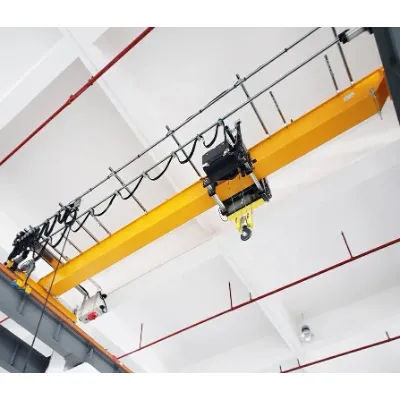
An overhead crane normally has three main powered movements:
- Hoisting – Hook up and down
- Trolley travel – Left and right
- Crane travel – Forward and backward
Modern VFD-controlled cranes can use dedicated variable-frequency control for these different motion systems.
The control parameters, motor characteristics, braking requirements and safety logic need to match each mechanism.
So a properly designed VFD crane is a complete control system, not simply an ordinary crane with a random inverter added later.
1. Hoisting VFD – Controls Hook Movement
The hoisting VFD controls the lifting and lowering movement of the hook.
This is especially important when handling:
- Machinery
- Molds
- Motors
- Precision equipment
- Large steel structures
- Fragile components
When approaching the required position, the operator can use a lower speed for more accurate placement.
Instead of the load suddenly starting or stopping, the hook movement can be controlled more smoothly.
2. Trolley VFD – Controls Left and Right Travel
The trolley moves horizontally along the crane bridge.
If the trolley accelerates or stops too quickly, the load can swing significantly.
VFD control allows the trolley to accelerate and decelerate more gradually.
This helps reduce load swing and makes positioning easier.
For assembly lines and machinery workshops, this can be particularly valuable.
3. Crane Travel VFD – Controls the Whole Crane
The third movement is the travel of the entire crane along the runway.
This is normally called long travel or crane travel.
VFD control allows the entire bridge crane to start smoothly, accelerate progressively and decelerate before stopping.
This can reduce shock on:
- Crane wheels
- Runway rails
- Drive motors
- Gearboxes
- Crane structure
It also makes operation feel noticeably smoother.
Traditional Crane vs VFD Crane
Item | Traditional Crane | VFD Crane |
|---|---|---|
Starting | Relatively abrupt | Smooth acceleration |
Stopping | Relatively abrupt | Smooth deceleration |
Speed Control | Fixed/stepped depending on design | Wide adjustable range |
Load Swing | Usually more noticeable | Easier to control |
Positioning | Less precise | More precise |
Mechanical Shock | Higher | Lower |
Motor Starting Stress | Higher | Reduced |
Operator Control | Basic | Smoother and more flexible |
Precision Handling | Limited | Better |
Initial Cost | Lower | Higher |
Does VFD Control Save Electricity?
This question needs to be considered carefully.
VFD control can improve motor operation and reduce some losses associated with certain traditional speed-control methods.
For example, older resistance-based speed control can dissipate energy as heat.
However, it is not correct to say that every VFD crane will automatically save a fixed percentage of electricity.
Actual energy consumption depends on:
- Crane capacity
- Motor power
- Operating frequency
- Load spectrum
- Travel distance
- Acceleration settings
- Braking system
- Regenerative technology
- Daily working hours
Therefore, the more reliable advantage of VFD control is better motion control, smoother operation and reduced mechanical shock.
Energy savings can be an additional benefit depending on the application and system design.
Why Are VFD Systems Common on European-Style Overhead Cranes?
Modern European-style overhead cranes focus strongly on:
- Low headroom
- Compact structure
- Smooth operation
- Accurate positioning
- Lower dead weight
- Intelligent control
For this reason, variable-frequency control is commonly integrated into their motion-control design.
The hoist, trolley and crane travel mechanisms can be designed together with suitable motors, brakes, reducers and control parameters.
This provides better overall performance than treating the VFD as an isolated electrical accessory.
Can You Add a VFD to an Existing Traditional Crane?
In some cases, yes.
An existing crane can potentially be upgraded with variable-frequency control.
However, you should not simply purchase a VFD and connect it directly to the existing motor.
Before upgrading, check:
- Motor type
- Motor insulation
- Brake system
- Control cabinet
- Electrical protection
- Limit switches
- Travel motors
- Hoisting motor
- Existing control logic
- Crane operating duty
Hoisting applications are especially important because lifting a suspended load requires appropriate braking and safety control.
The retrofit should therefore be designed as a crane control system rather than a simple electrical modification.
When Is a VFD Crane Worth the Extra Cost?
A VFD crane is particularly useful when your factory has:
Frequent Lifting
If the crane starts and stops hundreds of times per day, smoother acceleration and deceleration can reduce repeated mechanical shock.
Precision Assembly
When positioning machines, molds or components, low-speed control makes it easier to place the load accurately.
Fragile or Valuable Loads
Excessive load swing increases handling risk.
Smooth crane movement can provide better control.
Long Lifting Heights
With longer ropes, suspended loads can swing more noticeably during sudden acceleration and braking.
Heavy-Duty Production
Steel plants, machinery factories, precast plants and fabrication workshops can benefit from smoother and more controllable crane movement.
When Is a Traditional Crane Still a Good Choice?
VFD is not necessary for every project.
If your crane:
- Operates only occasionally
- Handles simple materials
- Does not require accurate positioning
- Has a limited budget
- Has relatively low operating frequency
a conventional crane may still meet your requirements.
For example, a small workshop lifting steel scrap only several times per day may not need the same control system as a production line handling precision machinery hundreds of times per shift.
The correct choice should depend on the application rather than simply choosing the most expensive configuration.
Example: 10 Ton Workshop Overhead Crane
Suppose two factories both need a 10 ton overhead crane.
Factory A
Lifts steel materials 10–20 times per day.
Accurate positioning is not important.
A conventional configuration may be sufficient.
Factory B
Lifts molds and machinery more than 100 times per day.
Loads need accurate positioning during assembly.
In this case, a VFD-controlled crane can provide significant operational advantages.
The crane can accelerate smoothly, travel quickly when appropriate, slow down near the target position and stop more steadily.
This is why two cranes with the same:
10 ton capacity + 20 meter span + 6 meter lifting height
may still require very different configurations.
FAQ
1. What does VFD mean on an overhead crane?
VFD means Variable Frequency Drive. It controls motor speed and allows the crane to accelerate and decelerate more smoothly.
2. What movements can use VFD control?
An overhead crane can use variable-frequency control for hoisting, trolley travel and crane travel, depending on the crane configuration.
3. Does a VFD crane reduce load swing?
Smooth acceleration and deceleration can reduce the forces that cause suspended loads to swing. However, operator technique, lifting height, travel speed and load characteristics also affect load sway.
4. Is a VFD crane more expensive?
Generally, yes. The electrical control system is more sophisticated than a basic conventional crane. However, the additional cost may be worthwhile for frequent operation, precision handling and applications requiring smooth movement.
5. Can I add a VFD to my old overhead crane?
Possibly. The existing motors, brakes, electrical system and control logic should first be evaluated to determine whether a VFD retrofit is suitable.
6. Is a European overhead crane always equipped with three VFDs?
Not necessarily. Configuration varies by manufacturer and application. Modern European-style cranes commonly use variable-frequency control for multiple motion mechanisms, but the exact number of drives depends on the crane design.
7. Which is better: a VFD crane or a traditional crane?
For frequent lifting, precision positioning and smooth material handling, VFD control generally provides better performance. For occasional simple lifting where budget is the priority, a conventional crane may be sufficient.
Conclusion
The biggest advantage of a VFD overhead crane is not simply that it can change speed.
The real advantage is better control of the entire lifting process.
Instead of sudden starting and stopping, VFD control allows smoother:
Acceleration → Travel → Deceleration → Positioning → Stop
And remember:
A properly designed VFD crane is not simply a traditional crane with one inverter added to the electrical cabinet.
Hoisting, trolley travel and crane travel are different movements with different control requirements.
When requesting a crane quotation, tell the supplier about your load type, daily lifting frequency and positioning requirements.
This will help determine whether a conventional crane or a VFD-controlled crane is the more suitable and economical choice.