Aug 7, 2026Buying Guide
Why Choose a Variable Frequency Overhead Crane?
Discover why a variable frequency overhead crane offers smoother starts, precise positioning, lower maintenance costs, and improved safety compared with conventional cranes.
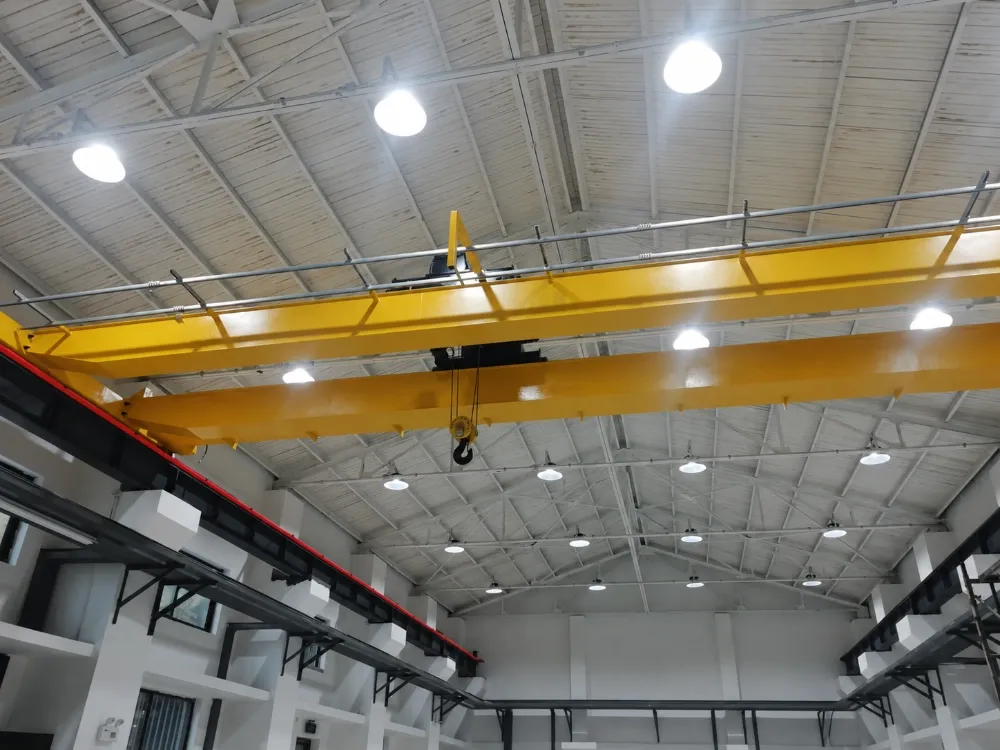
Why Choose a Variable Frequency Overhead Crane?
When purchasing an overhead crane, lifting capacity is only one part of the decision. The way a crane starts, stops, and moves can have an even greater impact on safety, productivity, and equipment lifespan.
Many experienced buyers specifically request a variable frequency overhead crane (VFD crane) because they value one important characteristic—smooth operation.
Unlike conventional cranes that accelerate and stop abruptly, a crane equipped with a Variable Frequency Drive (VFD) provides controlled acceleration and deceleration, reducing load swing and improving positioning accuracy.
Why Conventional Cranes Feel Less Stable
Traditional cranes operate at a fixed motor speed.
When the operator presses the control button, the crane often:
- Starts suddenly
- Stops abruptly
- Causes the load to swing
- Creates higher mechanical impact
- Produces unnecessary vibration
These sudden movements make it more difficult to handle valuable or heavy materials safely.
The larger the load, the more noticeable the swinging becomes.
Benefits of a Variable Frequency Overhead Crane
1. Smooth Starting and Braking
The biggest advantage of a VFD overhead crane is its ability to accelerate and decelerate gradually.
Instead of a sudden jerk, the motor increases speed smoothly, reducing impact on both the crane and the suspended load.
Benefits include:
- Less load swing
- Better operator control
- Reduced structural stress
- Improved lifting confidence
Smooth movement is especially valuable when handling precision equipment or fragile materials.
2. More Accurate Load Positioning
Precise positioning is essential in manufacturing, steel fabrication, machinery assembly, and warehouse operations.
Because a VFD controls motor speed continuously, operators can place loads exactly where needed without repeated corrections.
This improves:
- Installation accuracy
- Production efficiency
- Material handling precision
- Workplace safety
A smoother crane is also easier for new operators to control.
3. Reduced Mechanical Wear
Sudden starts and stops create impact forces throughout the crane.
These forces increase wear on components such as:
- Wheels
- Gearboxes
- Motors
- Couplings
- Bearings
- Brake systems
By reducing mechanical shock, a variable frequency drive helps extend the service life of these critical components and lowers maintenance costs.
4. Improved Safety
Load swing is one of the most common operational risks in overhead lifting.
A swinging load can:
- Hit surrounding equipment
- Damage products
- Increase operator risk
- Slow production
Because a VFD crane moves more smoothly, the suspended load remains much more stable during travel.
This makes lifting operations safer for both personnel and equipment.
Conventional Crane vs Variable Frequency Crane
Feature | Conventional Crane | Variable Frequency Crane |
|---|---|---|
Starting | Sudden | Smooth acceleration |
Braking | Abrupt | Controlled deceleration |
Load Swing | More noticeable | Significantly reduced |
Positioning Accuracy | Standard | High precision |
Mechanical Wear | Higher | Lower |
Operator Comfort | Average | Excellent |
Maintenance Cost | Higher over time | Lower over time |
Where Variable Frequency Cranes Perform Best
Variable frequency overhead cranes are particularly suitable for industries that require precise material handling, including:
- Steel fabrication
- Machinery manufacturing
- Automotive production
- Precast concrete plants
- Metal processing
- Warehouses and logistics centers
- Equipment assembly workshops
These applications benefit from smooth travel, accurate positioning, and improved operational safety.
Is a Variable Frequency Crane Worth the Extra Cost?
Although a VFD crane has a higher initial investment than a standard crane, many companies find that the additional cost is offset by long-term benefits.
A variable frequency system can help reduce:
- Maintenance expenses
- Component replacement frequency
- Downtime caused by mechanical wear
- Product damage from load swing
For facilities with frequent lifting operations, the return on investment is often achieved through increased productivity and reduced maintenance.
Conclusion
Choosing an overhead crane is not only about lifting capacity—it is also about how the crane performs every day.
A variable frequency overhead crane provides smoother acceleration, gentler braking, greater positioning accuracy, and lower mechanical wear than a conventional crane.
For businesses seeking higher productivity, safer lifting operations, and longer equipment life, investing in VFD technology is often a practical long-term decision.
Frequently Asked Questions
What is a variable frequency overhead crane?
A variable frequency overhead crane uses a Variable Frequency Drive (VFD) to control motor speed, allowing smooth acceleration, deceleration, and precise movement.
Does a VFD reduce load swing?
Yes. Because the crane accelerates and decelerates gradually, the suspended load experiences less sudden movement, significantly reducing load swing.
Can an existing overhead crane be upgraded with a VFD?
In many cases, yes. Existing cranes can often be retrofitted with variable frequency drives, although compatibility depends on the motor, electrical system, and control configuration.
Is a VFD crane suitable for heavy-duty lifting?
Yes. Variable frequency technology is widely used on both single girder and double girder overhead cranes, improving control and safety across a wide range of lifting capacities.