Aug 18, 2026Maintenance
Why Does an Overhead Crane Girder Deflect Too Much?
Why does an overhead crane girder develop excessive deflection? Learn how girder design, steel plate thickness, welding, camber and overloading affect crane safety.
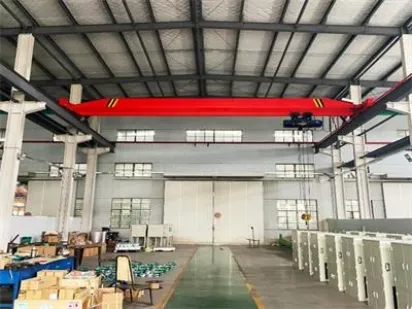
Why Does an Overhead Crane Girder Deflect Too Much?
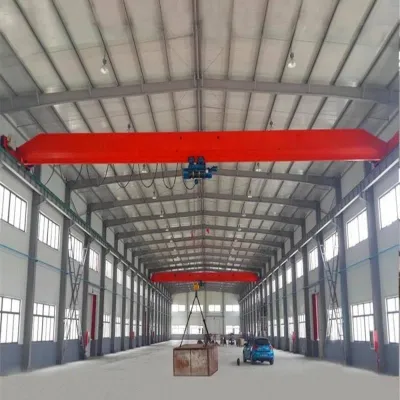
When an overhead crane lifts a load, the main girder will naturally deflect slightly.
This is normal.
But if the deflection becomes excessive, or the main girder cannot return to its expected geometry after unloading, the crane may have a structural problem.
So why does excessive girder deflection happen?
It is easy to blame overloading, but overload is not the only possible cause.
Problems may also be related to:
- Inadequate girder design
- Incorrect steel plate selection
- Insufficient structural stiffness
- Improper welding sequence
- Welding deformation
- Loss of designed camber
- Repeated heavy-duty operation
- Overloading or shock loading
For crane buyers, this means one thing:
Don't judge a single girder overhead crane only by its price and appearance. The main girder is one of the most important structures you should evaluate.
Normal Deflection vs Excessive Deflection
First, we need to understand an important difference.
Normal Elastic Deflection
When the crane lifts a load, the main girder bends slightly downward.
After the load is removed, the girder returns toward its original geometry.
This is elastic deformation and is expected within the crane's design limits.
Excessive or Permanent Deformation
The situation is different if:
- Deflection exceeds the allowable design criteria
- The girder develops abnormal sagging
- The designed camber is significantly reduced
- The girder remains abnormally deformed after unloading
These conditions require investigation.
A crane girder does not need to remain perfectly straight under load, but it must perform within its design requirements.
1. Girder Design Is the Starting Point
A common mistake is to judge crane quality by looking only at steel plate thickness.
For example:
6 mm must be better than 5 mm.
This is too simple.
The required main girder structure depends on several factors:
- Rated capacity
- Crane span
- Girder height
- Girder section
- Steel grade
- Web thickness
- Flange thickness
- Stiffener arrangement
- Hoist weight
- Duty class
- Load spectrum
Consider two cranes:
Crane A
5-ton capacity
10-meter span
Light-duty operation
Crane B
5-ton capacity
24-meter span
Frequent operation
They have the same rated capacity.
But their structural requirements can be very different.
Therefore, steel thickness should be determined by structural design rather than by one universal number.
2. Steel Plate Thickness Still Matters
Although thicker does not automatically mean better, steel plate thickness is still an important part of the crane design.
For a fabricated girder, the web and flange plates work together to provide the required:
- Strength
- Stiffness
- Stability
If the actual steel plate used during production is thinner than specified in the approved design, the structural performance may be affected.
This is why buyers should ask for more than:
"Is your steel thick?"
Ask:
- What steel grade is used?
- What is the web plate thickness?
- What is the flange plate thickness?
- Does the actual material match the drawing?
- Is a material certificate available?
These questions are much more useful.
Is a 5 mm Web Plate Unsafe?
Not automatically.
This point is important.
You cannot determine whether a crane girder is safe simply by saying:
Below 5 mm = unsafe
6–8 mm = safe
The correct thickness depends on the crane design.
For some smaller cranes, a particular thickness may be appropriate.
For larger-span or heavier-duty cranes, a thicker plate or different girder structure may be required.
Therefore:
The important question is whether the actual steel structure matches the engineering design.
If your supplier specifies a 6 mm or 8 mm web plate for a particular crane, that specification should correspond with the crane's structural calculation and manufacturing drawings.
3. Welding Can Affect Main Girder Camber
Steel selection is only one part of manufacturing.
Welding is another critical factor.
During welding, the steel is heated and then cools.
As the weld cools, shrinkage occurs.
If the welding procedure and sequence are poorly controlled, this can cause unwanted deformation.
Possible problems include:
- Girder twisting
- Local deformation
- Loss of straightness
- Dimensional deviation
- Changes in designed camber
This is why main girder manufacturing is not simply:
Put the steel together → Weld everything → Finish
The welding sequence needs to be planned.
How Can Welding Reduce the Designed Camber?
Many fabricated crane girders are manufactured with a designed upward camber.
This means the middle of the unloaded girder may be intentionally slightly higher.
During manufacturing, however, welding introduces heat and shrinkage.
If the welding sequence and deformation control are inappropriate, weld shrinkage may alter the intended girder geometry.
The finished main girder may therefore have less camber than intended or develop other geometric deviations.
That is why manufacturers should control:
- Assembly sequence
- Welding sequence
- Welding parameters
- Heat input
- Symmetry of welding where applicable
- Girder geometry during fabrication
After manufacturing, the final girder geometry should be checked according to the applicable requirements.
4. What Is Main Girder Pre-Camber?
Pre-camber is an intentional upward curvature incorporated into the girder according to the crane design.
It should not be understood as:
"The manufacturer bent the crane because the steel was too weak."
It is a designed geometric feature used in certain crane girder designs.
When the crane is loaded, the girder experiences downward deflection.
Correct girder design considers how the structure behaves under the specified loads.
Therefore, when inspecting a crane, don't only look at:
- Paint
- Weld appearance
- Crane color
Also pay attention to the main girder geometry.
5. Welding Quality Is More Than a Beautiful Weld
A smooth-looking weld is not automatically a good structural weld.
Welding quality involves:
- Joint preparation
- Welding procedure
- Welding consumables
- Welding parameters
- Welder qualification
- Weld dimensions
- Deformation control
- Inspection
Depending on the crane design, applicable standard and technical requirements, critical welds may also require appropriate non-destructive testing (NDT).
Methods may include:
- Visual Testing (VT)
- Ultrasonic Testing (UT)
- Magnetic Particle Testing (MT)
- Radiographic Testing (RT)
The required method and acceptance level depend on the specific weld and applicable manufacturing requirements.
So instead of asking:
"Do you inspect the welds?"
ask:
"Which welds are inspected, which NDT method is used, and what acceptance criteria are applied?"
That is a much more professional purchasing question.
6. Overloading Can Also Cause Excessive Deflection
Even a correctly manufactured crane can be damaged by improper operation.
For example:
A 5-ton crane should not be routinely used to lift loads beyond its rated capacity.
Overloading increases stress throughout the crane system, including:
- Main girder
- Hoist
- Trolley
- Wire rope
- Hook
- End trucks
- Wheels
- Structural connections
Repeated or severe overloading may contribute to excessive deformation or structural damage.
The fact that a crane successfully lifted an overloaded object once does not prove that the operation was safe.
7. Frequent Heavy Loads Must Be Considered
There is another situation:
The crane is technically not overloaded, but it operates close to its rated capacity throughout the day.
For example:
Factory A
5-ton crane
Usually lifts 1–2 tons
10 lifts per day
Factory B
5-ton crane
Frequently lifts 4–5 tons
Hundreds of movements per day
These are very different working conditions.
This is why crane duty class and load spectrum need to be considered during crane selection.
If a crane is selected only by maximum tonnage without considering operating frequency, the final equipment may not be appropriate for the actual production requirement.
How Does a Good Manufacturer Control Girder Deflection?
There is no single trick.
It is a complete process.
Step 1: Correct Structural Design
Determine the appropriate:
Capacity + Span + Duty + Girder Section + Steel Specification
Step 2: Material Control
Confirm that the actual steel material and plate dimensions match the manufacturing drawings.
Step 3: Controlled Assembly
Keep the girder geometry within the required manufacturing tolerances.
Step 4: Controlled Welding
Use appropriate welding procedures and sequences to control distortion.
Step 5: Weld Inspection
Inspect critical welds according to the applicable technical requirements.
Step 6: Girder Geometry Measurement
Check the finished girder's:
- Camber
- Straightness
- Dimensions
- Other specified geometric requirements
Step 7: Final Crane Inspection
Verify that the completed crane meets the specified manufacturing and performance requirements.
In other words:
Good girder performance comes from design + material + welding + inspection, not from steel thickness alone.
What Should Buyers Check Before Purchasing a Single Girder Crane?
Here is a practical checklist.
Item | What to Ask the Supplier |
|---|---|
Steel grade | What steel material is used? |
Material certificate | Is it available? |
Web plate | What thickness is specified? |
Flange plate | What thickness is specified? |
Girder structure | How is it designed? |
Camber | How is it controlled and measured? |
Welding | What welding process is used? |
NDT | Which critical welds are tested? |
Duty class | Is it suitable for my working frequency? |
Deflection | What design criteria are applied? |
Inspection | What records are available before delivery? |
Don't simply ask:
"How much is your 5-ton crane?"
Two 5-ton cranes can have very different:
Span + Structure + Steel + Duty + Components + Manufacturing Quality
That is one reason crane quotations can differ significantly.
Cheap Crane vs Properly Designed Crane
Low price does not automatically mean poor quality.
High price does not automatically mean good quality either.
The better way to compare quotations is to make sure you are comparing the same technical specification.
For example:
Specification | Supplier A | Supplier B |
|---|---|---|
Capacity | 5 ton | 5 ton |
Span | 20 m | 20 m |
Duty class | ? | ? |
Steel grade | ? | ? |
Web thickness | ? | ? |
Flange thickness | ? | ? |
Hoist | ? | ? |
Motor | ? | ? |
Welding inspection | ? | ? |
Surface treatment | ? | ? |
Once these specifications are clear, the price comparison becomes much more meaningful.
Special Considerations for Southeast Asia and Africa
Crane buyers in Southeast Asia and Africa should also consider the operating environment.
Southeast Asia
Common considerations may include:
- High humidity
- Coastal environments
- Heavy rainfall
- High ambient temperature
Corrosion protection and electrical component protection can therefore be important.
Africa
Conditions vary significantly by country and location.
Depending on the project, buyers may need to consider:
- High temperatures
- Dust
- Outdoor operation
- Coastal corrosion
- Voltage conditions
- Spare-parts availability
When requesting a crane quotation, provide the actual installation location and operating environment.
This helps the supplier select an appropriate configuration.
FAQ About Overhead Crane Girder Deflection
Is overhead crane girder deflection normal?
Yes.
A crane girder normally experiences some elastic deflection under load.
The important question is whether it remains within the applicable design requirements and behaves as intended after unloading.
Why does an overhead crane girder deflect too much?
Possible causes include inappropriate structural design, manufacturing deviations, overload, abnormal operating conditions, damage or other structural problems.
The actual cause should be determined through inspection.
Does thin steel plate cause excessive crane girder deflection?
Insufficient structural stiffness can contribute to excessive deflection, but steel plate thickness cannot be evaluated independently.
Capacity, span, girder section, steel grade, reinforcement and duty class must all be considered.
Is a 5 mm web plate too thin for an overhead crane?
Not necessarily.
There is no universal rule stating that every crane web below 5 mm is unsafe.
The correct thickness should be determined by the crane's structural design.
Is a 6–8 mm web plate always better?
No.
A thicker plate alone does not guarantee a better crane.
The complete girder design and manufacturing quality are more important.
Can welding affect crane girder camber?
Yes.
Welding introduces heat and shrinkage, which can affect girder geometry if deformation is not properly controlled during fabrication.
What is crane girder pre-camber?
Pre-camber is a designed upward curvature incorporated into certain crane girders according to their structural design.
It should be controlled during manufacturing and checked according to the applicable requirements.
Does every main girder weld need radiographic testing?
Not necessarily.
The required inspection method depends on the weld type, structural design, applicable standard and technical specification.
Different welds may require different inspection methods and acceptance criteria.
Can overloading permanently deform a crane girder?
Severe or repeated overloading can create excessive structural stress and may lead to permanent deformation or other damage.
A crane should be operated within its rated capacity.
What should I do if my crane girder remains bent after unloading?
Stop normal operation and arrange a professional inspection.
Permanent or unexpected deformation should not simply be ignored.
Final: Don't Compare Single Girder Cranes by Price Alone
When purchasing a single girder overhead crane, it is easy to compare only:
5 ton vs 5 ton
20 m span vs 20 m span
$10,000 vs $8,000
But those numbers do not tell the whole story.
The main girder depends on:
Structural Design + Steel Material + Plate Thickness + Welding Process + Camber Control + Inspection
Steel thickness matters.
Welding matters.
But neither should be evaluated alone.
For buyers, the most important thing is to confirm that:
The actual materials and manufacturing process match the approved crane design and your real working conditions.
So before choosing the cheapest quotation, ask the supplier for the technical specification.
For a lifting machine, the main girder is not the place to make an uninformed compromise.