Aug 21, 2026Buying Guide
Overhead Crane vs Gantry Crane: Which Is Cheaper to Install?
Overhead crane or gantry crane—which is cheaper for a workshop without crane runway beams? Compare crane price, steel columns, foundations, rails and installation costs.
Overhead Crane or Gantry Crane: Which Costs Less?
If your workshop does not have existing crane runway beams or support brackets, you may have two options:
- Install an overhead crane with a new independent support structure
- Install a gantry crane with floor-level rails
Which one is cheaper?
There is no fixed answer.
If you compare only the crane equipment, a gantry crane will often cost more because it has additional supporting legs and related steel structures.
But an overhead crane requires an elevated runway system. If your existing workshop does not have suitable crane supports, you may need to add independent steel columns, runway beams and foundations.
Therefore, you should compare the total installed cost, not only the crane price.
Option 1: Installing a Gantry Crane
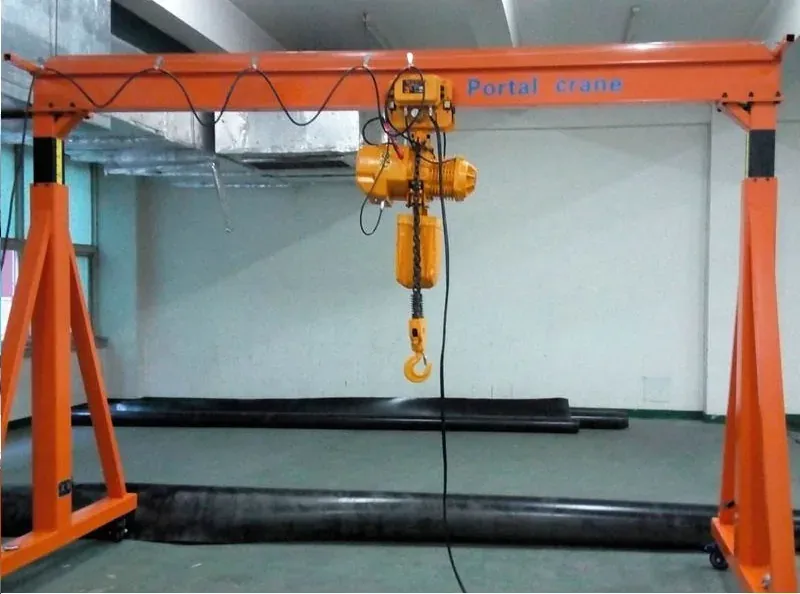
A gantry crane has its own supporting legs.
The crane does not need a conventional elevated runway beam system supported by the workshop structure.
However, this does not mean there are no additional costs.
A typical rail-mounted gantry crane project may include:
- Gantry crane equipment
- Crane legs
- Ground foundation
- Crane rails
- Electrical system
- Installation
- Transportation
Because a gantry crane contains more structural steel than a comparable overhead crane, its equipment price may be higher.
[Internal Link: Gantry Crane]
What Makes a Gantry Crane More Expensive?
1. Additional Supporting Legs
An overhead crane mainly consists of the bridge, end carriages and hoisting mechanism.
A gantry crane also requires supporting legs to transfer loads to the ground.
More steel usually means a higher equipment cost.
2. Ground Foundation
For a conventional rail-mounted gantry crane, the ground and rail foundation need to withstand crane wheel loads.
Depending on the project, this may involve:
- Excavation
- Reinforced concrete
- Embedded components
- Crane rail installation
- Rail alignment
These civil works should be included when calculating the project budget.
3. Rail Installation
The crane needs a properly installed runway on the ground.
The longer the crane travel distance, the more the rail and foundation work may affect the total cost.
Option 2: Installing an Overhead Crane
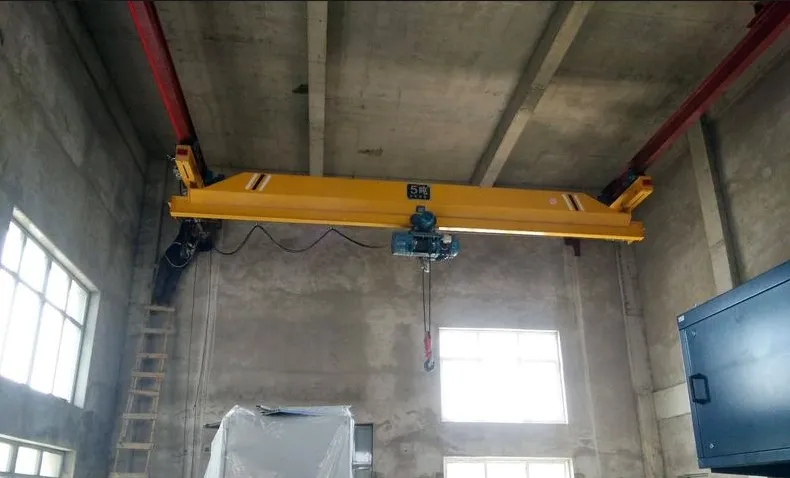
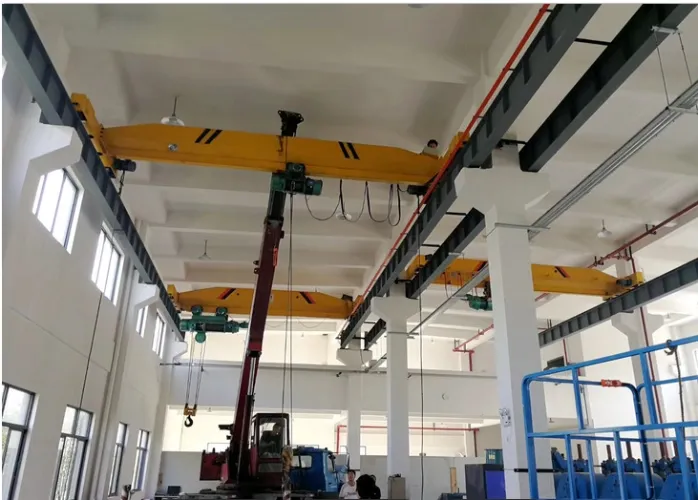
If the workshop already has suitable crane runway beams, an overhead crane can be a very economical solution.
But the situation changes when the building has no crane runway support system.
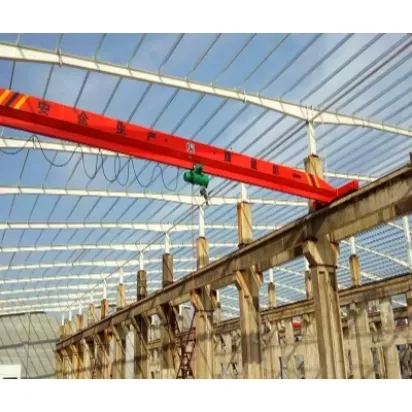
In this case, you may need to build an independent steel structure inside the workshop.
The complete system may include:
- Overhead crane
- Independent steel columns
- Column foundations
- Crane runway beams
- Crane rails
- Bracing and connections
- Electrical system
- Installation
[Internal Link: Single Girder Overhead Crane]
The Crane May Be Cheaper, But the Support Structure Is Not Free
This is where many buyers make a mistake.
For example:
5 ton overhead crane: lower equipment price
vs.
5 ton gantry crane: higher equipment price
Looking only at these two quotations, the overhead crane seems cheaper.
But if the workshop has no crane runway structure, the real comparison should be:
Overhead Crane Cost
Crane
- Steel columns
- Column foundations
- Runway beams
- Rails
- Installation
VS
Gantry Crane Cost
Crane
- Ground foundation
- Rails
- Installation
Once all these costs are included, the difference may become much smaller—or the result may even change.
What Determines the Final Cost?
Several factors can significantly affect the price.
Crane Capacity
A 3 ton crane and a 20 ton crane require very different structures.
As capacity increases, crane self-weight, wheel loads and structural requirements also increase.
Crane Span
A longer span normally requires a larger main girder.
It can also increase the structural requirements of the runway system.
Travel Length
If the crane needs to travel 20 meters, 50 meters or 100 meters, the cost of rails, foundations and runway structures will be very different.
This is particularly important when comparing the two solutions.
Existing Workshop Structure
If your workshop already has strong structural columns that can potentially be incorporated into the crane support design after engineering verification, the project may be different from a workshop that requires a completely independent support structure.
Never assume that existing building columns can directly carry crane loads without structural verification.
Ground and Foundation Conditions
Poor soil conditions or an existing floor that cannot support crane loads can increase civil construction costs.
Overhead Crane vs Gantry Crane Cost Comparison
Cost Item | Overhead Crane | Gantry Crane |
|---|---|---|
Crane Equipment | Usually lower | Usually higher |
Supporting Legs | No | Yes |
Independent Steel Columns | May be required | No |
Elevated Runway Beams | Required | No |
Ground Rail Foundation | Depends on design | Usually required for rail-mounted type |
Crane Rails | Required | Required |
Floor Space Occupied | Low | Higher |
Civil/Structural Cost | Depends heavily on workshop | Depends heavily on ground conditions |
Total Cost | Project-specific | Project-specific |
The cheapest crane is not necessarily the cheapest complete project.
Example: 5 Ton Crane for an Existing Workshop
Suppose you need:
- Capacity: 5 tons
- Span: 15 meters
- Travel length: 40 meters
- Existing crane runway: No
Plan A: Overhead Crane
You may need:
5 ton overhead crane + independent columns + foundations + runway beams + rails + installation
Plan B: Gantry Crane
You may need:
5 ton gantry crane + ground foundation + rails + installation
At this stage, simply asking:
“How much is a 5 ton crane?”
is not enough to determine which solution is cheaper.
Both complete systems should be calculated using the same workshop dimensions.
Then you can compare the final project costs directly.
Don't Compare Only the Initial Price
Cost is important, especially for factories in emerging markets where construction budgets may be limited.
But the cheapest initial quotation may not provide the lowest long-term cost.
You should also consider:
- Available workshop floor space
- Forklift routes
- Required lifting height
- Crane operating frequency
- Maintenance
- Future production expansion
- Installation time
- Civil construction requirements
For example, a gantry crane may have an attractive total installation cost in one workshop, but its legs could interfere with forklifts and production lines.
In another workshop, building independent columns for an overhead crane may require extensive civil construction.
The right solution depends on the site.
What Information Do We Need to Compare Both Options?
If your workshop has no existing crane runway structure, provide:
Crane capacity: ___ tons
Workshop width: ___ m
Workshop length: ___ m
Workshop clear height: ___ m
Required crane span: ___ m
Required lifting height: ___ m
Travel length: ___ m
Maximum load: ___ tons
Material to be lifted: ___
Working frequency: ___
You can also send workshop photos, drawings or a simple hand-drawn layout.
With this information, both solutions can be evaluated:
Plan A: Overhead Crane + Independent Runway Structure
Plan B: Gantry Crane + Ground Runway
Then you can compare which solution is more economical for your actual workshop.
FAQ
1. Is a gantry crane more expensive than an overhead crane?
If comparing only similar-capacity crane equipment, a gantry crane may cost more because it includes supporting legs and additional steel structures. However, the total installed project cost can be different.
2. Is an overhead crane cheaper if my workshop has no crane runway beams?
Not necessarily. The crane itself may be cheaper, but you may need additional steel columns, foundations, runway beams and rails.
3. Does a gantry crane need a foundation?
A conventional rail-mounted gantry crane generally requires a properly designed runway and foundation capable of supporting the crane wheel loads. The actual foundation design depends on crane loads and ground conditions.
4. Which crane is better for a small workshop?
If floor space is limited, an overhead crane often has an advantage because the lifting system operates above the production area. A gantry crane requires space for its legs and ground runway.
5. What affects crane installation cost the most?
Capacity, span, travel length, existing workshop structure, foundation conditions, runway requirements and installation conditions can all significantly affect the total cost.
6. How can I know which solution is cheaper for my workshop?
The best method is to calculate both complete solutions using the same site information and compare the total installed cost, rather than comparing only crane equipment prices.
Conclusion
So, which is cheaper: an overhead crane or a gantry crane?
There is no universal answer.
A gantry crane usually has more structural steel and requires a ground runway and foundation.
An overhead crane may have a lower equipment price, but if your workshop has no existing crane runway structure, you may need to build foundations, independent columns and runway beams.
The correct comparison is:
Crane + Steel Structure + Foundation + Rails + Installation
Send us your capacity, span, lifting height, travel length and workshop dimensions.
We can compare both solutions for the same project so you can clearly see which option is more economical.