Aug 11, 2026Buying Guide
Why Is an Overhead Crane Girder Cut Into Sections for Transport?
Why are long overhead crane girders divided into sections before delivery? Learn how crane girders are designed, transported, connected and installed safely.
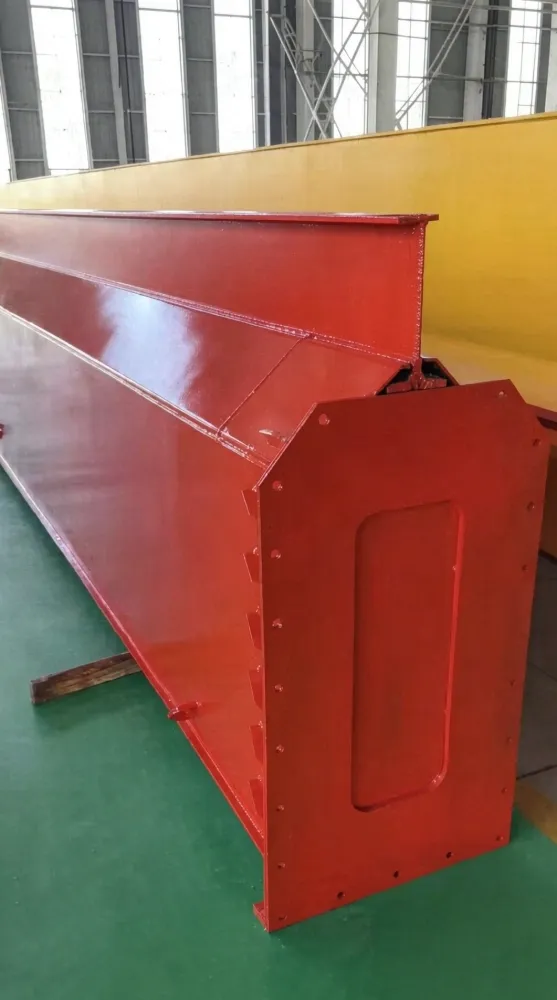
Why Is an Overhead Crane Girder Cut Into Sections for Transport?
If you have ever bought or installed a long-span overhead crane, you may have noticed something interesting:
Why isn't the main girder delivered as one complete piece?
Many customers see a long crane girder divided into two or more sections and immediately ask:
"Will cutting the girder affect its lifting capacity?"
In most properly designed crane projects, sectionalizing the girder is a normal solution for transportation and installation.
The key is not simply where the girder is divided.
The key is how the connection is designed, manufactured, transported and installed.
Why Is the Crane Main Girder Divided Into Sections?
The main reason is simple:
Transportation.
- Lifting capacity
- Span
- Lifting height
- Working class
- Crane type
- Structural requirements
As the crane span becomes longer, the girder also becomes larger.
A very long girder may be difficult or even impractical to transport as one complete piece.
This becomes especially important for international export projects.
For example, when exporting a crane from China to Southeast Asia, Africa or other overseas markets, the equipment may need to be transported by:
- Container
- Flatbed truck
- Trailer
- Sea freight
- Road transportation
A complete long girder may exceed the available transportation dimensions.
Therefore, the girder can be manufactured in several sections and assembled at the installation site.
Is Cutting the Crane Girder Safe?
Yes, if the sectionalized girder and connection are properly designed and manufactured for that purpose.
The word "cut" can sound alarming.
But in professional crane manufacturing, this does not mean simply cutting a finished girder in half and bolting it back together.
Instead, the crane manufacturer designs the girder as transportable sections from the beginning.
The connection may use a specially designed:
Flange and high-strength bolt connection
or another engineered connection method according to the crane design.
The connection must be designed to transfer the required forces between the girder sections.
This means the connection is part of the structural design, not an afterthought.
How Are Crane Girder Sections Connected?
One common method is a flange connection with high-strength bolts.
The two girder sections are manufactured with matching connection plates.
During installation:
- The two sections are positioned correctly.
- The flange plates are aligned.
- Bolts are inserted.
- Bolts are tightened according to the specified procedure.
- The connection is inspected.
- The complete girder is checked before crane commissioning.
The exact connection design depends on the crane type, girder structure, load requirements and applicable design standard.
For export projects, the supplier should provide clear assembly instructions for the installation team.
Where Should the Crane Girder Be Divided?
This is one of the most important questions.
You may hear people say:
"The girder should always be divided at one-third of the span."
This should not be treated as a universal rule.
The sectional position should be determined by the crane's structural design and transportation requirements.
Engineers may consider:
- Girder span
- Crane capacity
- Girder self-weight
- Structural stress
- Deflection
- Connection strength
- Transportation dimensions
- Container dimensions
- Lifting and installation requirements
The location of the connection should be selected so that the complete girder can safely perform its intended function after assembly.
Therefore, do not ask only where the girder is cut. Ask how the connection has been engineered.
Why Is the Connection Usually Not Placed Randomly?
The crane girder is a structural component.
During operation, it is subjected to various forces caused by:
- Self-weight
- Hoisted load
- Trolley movement
- Crane travel
- Dynamic effects
- Repeated loading
The structural design needs to account for these conditions.
If a connection is placed in an unsuitable location or is poorly designed, it can affect:
- Structural strength
- Stiffness
- Deflection
- Fatigue performance
- Crane operation
- Long-term reliability
That is why the connection location should be determined during engineering design.
A professional manufacturer should not simply choose a convenient cutting point for transportation.
Why Is This Especially Important for Export Cranes?
For domestic projects, transportation dimensions may be relatively flexible.
For export projects, the situation can be more complicated.
The manufacturer needs to consider:
Container Dimensions
The crane components must fit within the selected container or transportation method.
Port Transportation
The equipment may need to pass through different loading and unloading processes.
Road Restrictions
The size and weight of individual components may be limited during inland transportation.
Site Installation
The customer may have limited lifting equipment at the installation site.
Therefore, export crane design is not only about the crane itself.
It is also about:
Manufacturing + transportation + installation.
What Happens After the Crane Arrives?
The installation process normally includes several steps.
Step 1: Check the Components
Before assembly, inspect:
- Girder sections
- Connection plates
- Bolts
- End trucks
- Hoist or trolley
- Electrical components
- Other supplied parts
Check for transportation damage.
Step 2: Position the Girder Sections
The sections are moved into the correct installation position using suitable lifting equipment.
The installation team should follow the manufacturer's assembly instructions.
Step 3: Align the Connection
The connection plates need to be correctly aligned before tightening.
Do not force components into position using inappropriate methods.
Correct alignment is important for the final structural condition.
Step 4: Install and Tighten the Bolts
Bolts should be installed and tightened according to the manufacturer's specified procedure.
Where torque requirements are specified, use the appropriate calibrated tools.
Step 5: Complete Inspection
After assembly, inspect the connection and the complete crane structure.
Depending on the project and applicable requirements, commissioning and testing may be required before the crane is put into normal operation.
Does a Sectionalized Girder Have Less Lifting Capacity?
Not necessarily.
A properly engineered sectionalized crane girder can be designed to meet the required lifting capacity after assembly.
The important factors include:
- Girder structural design
- Connection design
- Material
- Welding quality
- Bolt specification
- Manufacturing quality
- Installation quality
- Applicable design standard
Therefore, you should not judge a crane simply by asking:
"Is the main girder one piece?"
A better question is:
"Is the girder connection properly designed and manufactured for the required load and working conditions?"
What Are the Risks of a Poorly Made Girder Connection?
A sectionalized girder itself is not necessarily a problem.
The real concern is an incorrectly designed or improperly installed connection.
Potential problems may include:
- Loose bolts
- Poor alignment
- Incorrect bolt tightening
- Connection deformation
- Structural fatigue
- Excessive deflection
- Abnormal crane movement
In serious cases, structural problems can create significant safety risks.
This is why the connection should be treated as an important structural component.
How Can Buyers Check the Girder Connection Before Purchasing?
If you are buying an overhead crane for export, ask the supplier several questions.
1. Why is the girder divided into sections?
The supplier should be able to explain the transportation requirement and structural design.
2. How are the sections connected?
Ask whether the connection uses flange plates, high-strength bolts or another engineered connection.
3. Where is the connection located?
Ask for the engineering drawing rather than relying on a general rule such as "one-third of the span."
4. Is an assembly drawing provided?
The supplier should provide clear installation information.
5. Are bolt specifications provided?
You should know the bolt grade, quantity and tightening requirements where applicable.
6. Is an installation manual available?
This is particularly important for overseas projects where the customer may use a local installation team.
Crane Girder Transportation: One Piece vs. Sections
There are advantages and disadvantages to both approaches.
Method | Advantages | Considerations |
|---|---|---|
One-piece girder | No field girder joint | May be difficult to transport |
Sectionalized girder | Easier transportation and export | Requires proper site assembly |
Container-friendly sections | Suitable for overseas shipping | Requires accurate packing and installation |
Large welded section | Reduced field assembly | Transportation dimensions may become a problem |
The best solution depends on the project.
For long-span cranes and international export projects, sectionalized transportation can make logistics much easier.
Why Professional Engineering Matters
A crane girder is not simply a large steel beam.
It is a structural component designed to work together with:
- End trucks
- Hoisting equipment
- Trolley
- Runway system
- Electrical system
- Lifting load
- Crane controls
When the girder is divided into sections, the connection becomes an important part of this structural system.
Therefore, the design should be completed before manufacturing.
The manufacturer should consider both:
How will we transport it?
and
How will it perform after assembly?
FAQ About Sectionalized Overhead Crane Girders
Why are overhead crane girders divided into sections?
The main reason is transportation.
Long and heavy crane girders may be difficult to transport as one piece, especially for containerized international shipments. Dividing the girder into transportable sections can make shipping and installation more practical.
Does cutting a crane girder make it weaker?
Not necessarily.
A girder designed and manufactured as sectionalized components can use an engineered connection designed to transfer the required loads.
The quality of the connection and installation is critical.
Where should an overhead crane girder be divided?
There is no single universal position.
The location should be determined by the structural design, transportation requirements, connection design and applicable standards.
Do not assume that every crane must be divided at exactly one-third of the span.
How are crane girder sections connected?
A common solution is a flange connection using bolts, often with high-strength bolted connections where specified by the design.
The exact connection depends on the crane structure and engineering requirements.
Can a sectionalized crane be used for export?
Yes.
Sectionalized construction can be particularly useful for export projects because individual components can be designed to meet container and transportation limitations.
Can the customer install the girder on site?
Depending on the project, local installation teams may assemble the girder sections according to the manufacturer's installation instructions.
The required lifting equipment, tools and technical personnel depend on the crane design and site conditions.
What should I check before buying a sectionalized overhead crane?
Ask the supplier for:
- General arrangement drawing
- Girder connection drawing
- Connection specifications
- Bolt specifications
- Assembly instructions
- Installation requirements
- Testing and commissioning requirements
This information can make overseas installation much easier.
Final: A Divided Girder Does Not Mean a Weak Girder
When you see an overhead crane girder divided into two or more sections, don't immediately think:
"The manufacturer cut the beam to save money."
In many cases, the reason is simply transportation and installation.
For long-span or export cranes, sectionalized construction can make shipping more practical.
But the important thing is not whether the girder is divided.
The important things are:
Where is the connection?
How is it designed?
How is it manufactured?
How is it assembled?
Has the complete crane been properly inspected and commissioned?
A properly engineered girder connection can be an effective solution for transporting and installing large overhead cranes.
When purchasing an export crane, always ask the supplier to provide the structural drawings, connection details and installation instructions before shipment.