Aug 6, 2026Buying Guide
Can a Single Girder Crane Work Over 25 Meters?
Can a single girder overhead crane handle a 25 meter span? Learn why double girder cranes are usually recommended for wide-span workshops and heavy-duty lifting applications.
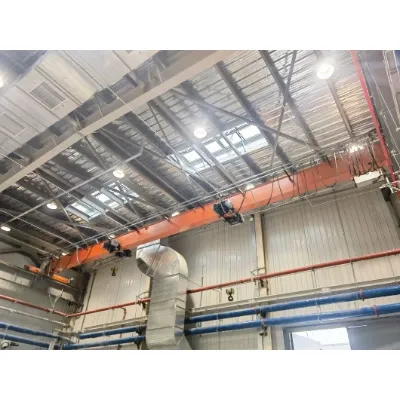
Can a Single Girder Crane Work Over 25 Meters?
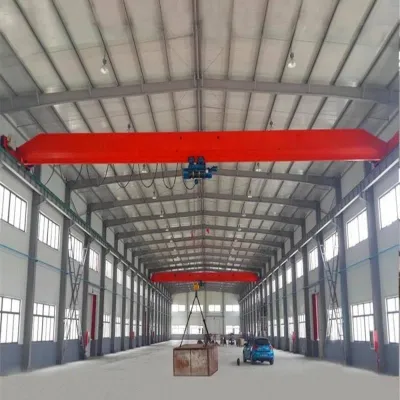
When designing an overhead crane for a large workshop, many customers ask:
Technically, it is possible to manufacture a single girder crane with a large span. However, for most industrial applications, a double girder overhead crane is usually the better choice when the span reaches or exceeds 25 meters.
The reason is not only lifting capacity, but also structural stability, deflection control, and long-term reliability.
What Is the Maximum Span of a Single Girder Crane?
A single girder overhead crane uses one main girder to support the trolley and lifting load.
Because all loads are concentrated on one beam, the main girder experiences:
- Bending stress
- Deflection
- Vibration
- Dynamic impact from lifting operations
As the span becomes longer, controlling these factors becomes increasingly difficult.
For common industrial applications:
Crane Type | Typical Application Span |
|---|---|
Single Girder Crane | Usually suitable for small and medium spans |
Double Girder Crane | Better choice for large spans and heavy-duty applications |
The exact design depends on lifting capacity, duty class, working environment, and customer requirements.
Why Is a Single Girder Crane Not Recommended Above 25 Meters?
1. Larger Deflection of the Main Girder
The longer the beam span, the easier it is for the structure to bend under load.
A single girder crane has only one main beam carrying the load, so the deflection becomes more noticeable when:
- Span increases
- Load capacity increases
- Lifting frequency increases
Excessive deflection affects crane operation accuracy and operator experience.
2. More Vibration During Operation
For wide-span single girder cranes, the beam structure may experience greater vibration when:
- The trolley moves quickly
- Heavy loads start or stop suddenly
- Loads swing during transportation
This can reduce working efficiency and make positioning loads more difficult.
3. Long-Term Fatigue Effects
Industrial cranes often work thousands of hours during their service life.
Repeated loading and unloading create cyclic stress on:
- Main girder welds
- Connection points
- Structural components
A crane with insufficient rigidity may experience faster fatigue over time.
Why Is a Double Girder Crane Better for Wide Workshops?
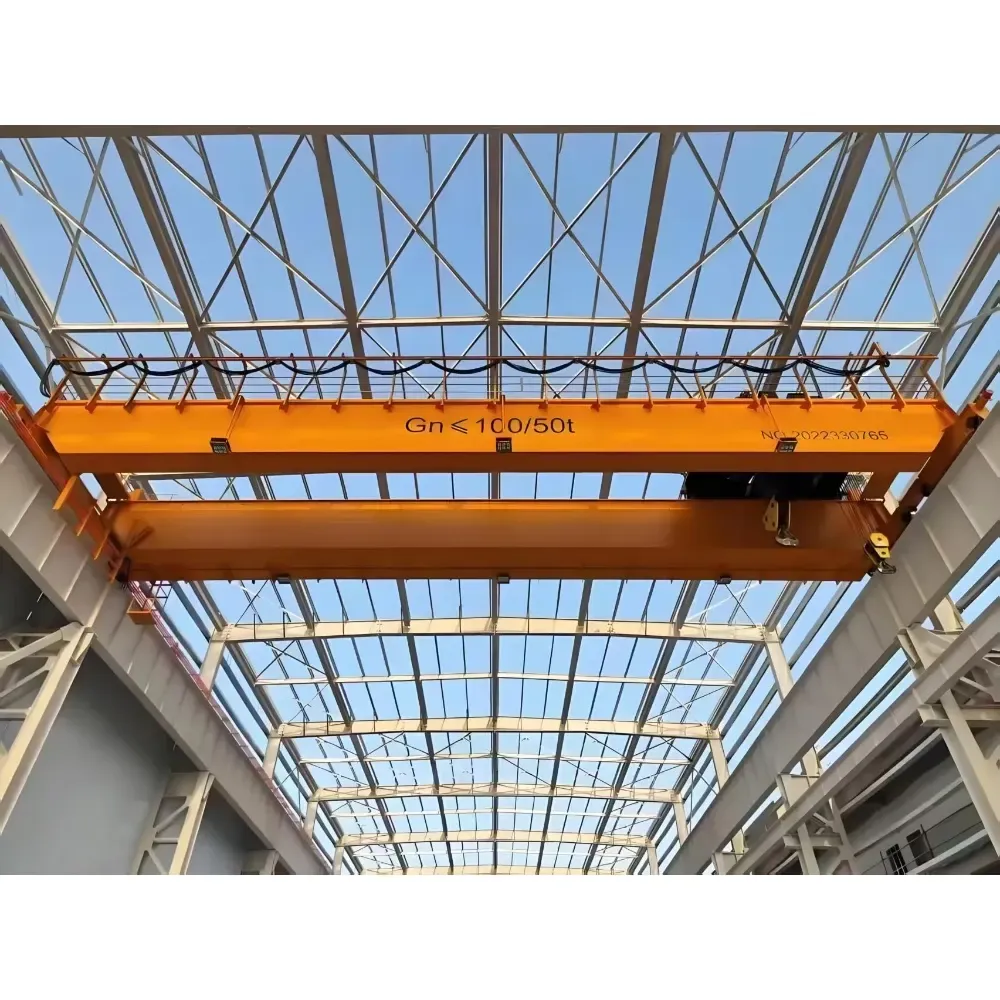
Compared with a single girder crane, it provides:
Higher Structural Rigidity
Two girders distribute the lifting load more evenly and reduce deformation.
Better Stability
The trolley runs on rails installed on the two girders, creating a more stable operating system.
This is especially important for:
- Heavy equipment lifting
- Steel manufacturing
- Machinery factories
- Large production workshops
Higher Lifting Capacity
Double girder cranes are commonly used for:
- 10 ton+
- 20 ton+
- 50 ton+
- Heavy-duty industrial applications
Single Girder vs Double Girder Crane Over 25 Meters
Comparison | Single Girder Crane | Double Girder Crane |
|---|---|---|
Main beam | One girder | Two girders |
Wide span capability | Limited | Excellent |
Structural rigidity | Lower | Higher |
Running stability | Moderate | Better |
Heavy load suitability | Limited | Excellent |
Initial cost | Lower | Higher |
Long-term durability | Depends on application | Better for heavy duty |
When Can a Single Girder Crane Still Be Used?
Not every 25-meter workshop requires a double girder crane.
A single girder crane may still be considered when:
- Lifting capacity is low
- Working frequency is low
- Loads are not heavy
- The duty class is light
- Cost control is important
The final selection should always be based on engineering calculations.
How to Choose the Right Crane for a Large Workshop?
Before selecting a crane, consider:
1. Workshop Span
The distance between runway beams directly affects crane design.
2. Lifting Capacity
Heavy loads require higher structural strength.
3. Working Frequency
A crane used several hours every day requires a higher duty classification.
4. Load Type
Different industries have different requirements:
- Steel structures
- Machinery manufacturing
- Precast concrete
- Warehouses
- Shipyards
Conclusion
Although single girder cranes can be designed for large spans, they are generally not the preferred solution when the workshop span exceeds 25 meters.
For wide-span factories requiring stable operation, frequent lifting, and long service life, double girder overhead cranes provide better rigidity, safety, and overall performance.
Choosing the right crane is not only about saving initial investment—it is about ensuring reliable operation for many years.
FAQ
1. Can a single girder crane span 25 meters?
Yes, it can be technically designed, but it may not be the most economical or stable solution depending on lifting capacity and working conditions.
2. What is the maximum span of a single girder overhead crane?
There is no absolute maximum span. The suitable span depends on load capacity, duty class, crane design, and structural requirements.
3. Is a double girder crane better for a large factory?
For large workshops with wide spans and heavy-duty lifting requirements, double girder cranes are usually recommended because they provide better stability and rigidity.
4. Why does a long single girder crane shake?
Long single girders have lower structural stiffness. During trolley movement or load acceleration, vibration and deflection become more noticeable.
5. Which crane is better for a 30-meter workshop?
For a 30-meter workshop, a double girder overhead crane is usually the preferred choice, especially for frequent lifting or heavy loads.